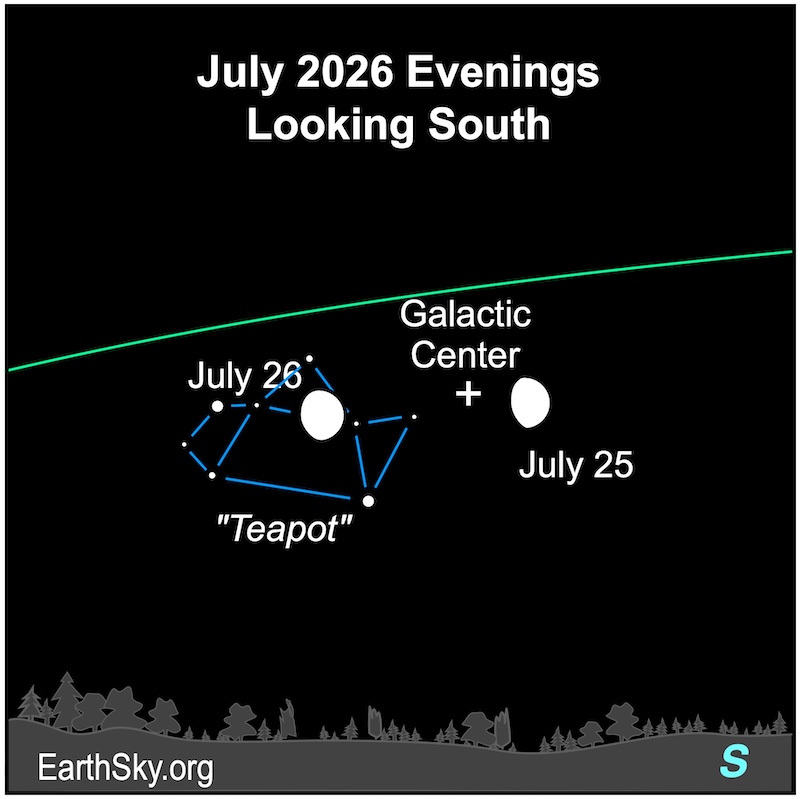
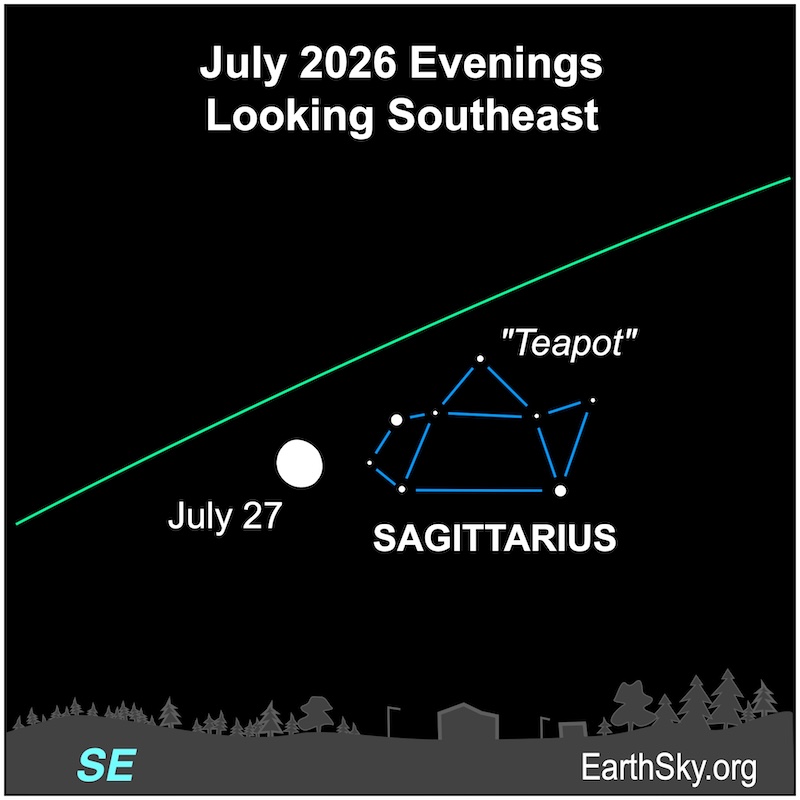
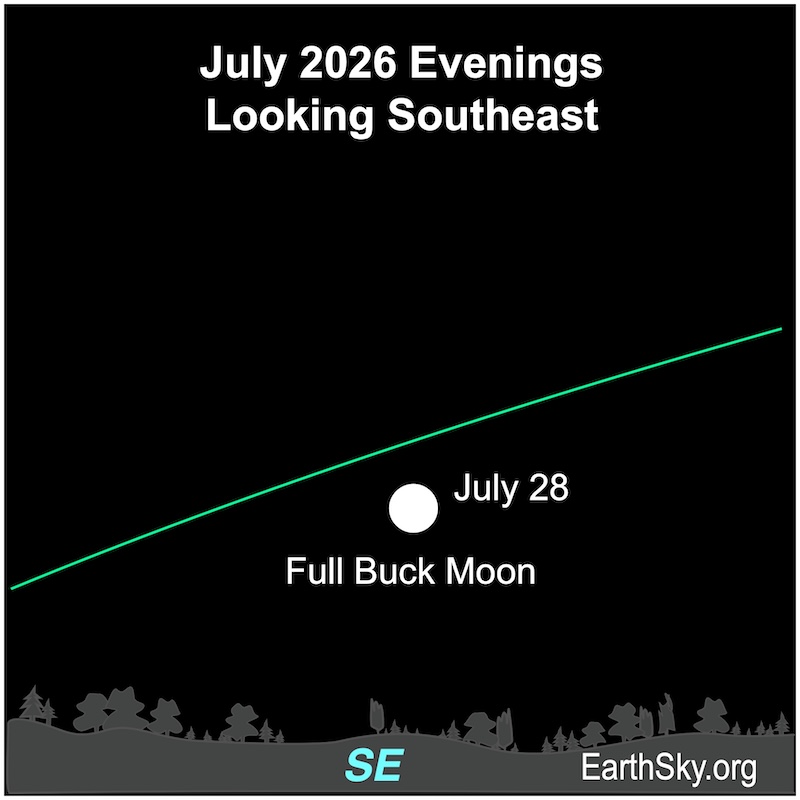
This evening, the waxing gibbous moon will float near the Teapot asterism of Sagittarius. That’s also close to the spot that marks the center of the Milky Way galaxy. Tomorrow evening, the moon will float among the stars of the Teapot. Due to the brightness of the moon, the Teapot will be difficult to discern on both evenings. They’ll rise before sunset and set before dawn the next morning. Chart via EarthSky.
Meteor season is here! The Delta Aquariid and Perseid meteor showers both are active now. The moon will determine your best viewing opportunities over the next few weeks. How? Join EarthSky’s Deborah Byrd for all the facts you should know about this year’s meteor viewing opportunities. Hint: it’s a terrific year for the Perseids! Watch here or on YouTube.
Next week’s best night sky sights
Marcy Curran brings you night sky highlights for next week. Like the full moon? Then watch here or on YouTube.
Late July: Watch for the Delta Aquariid meteors
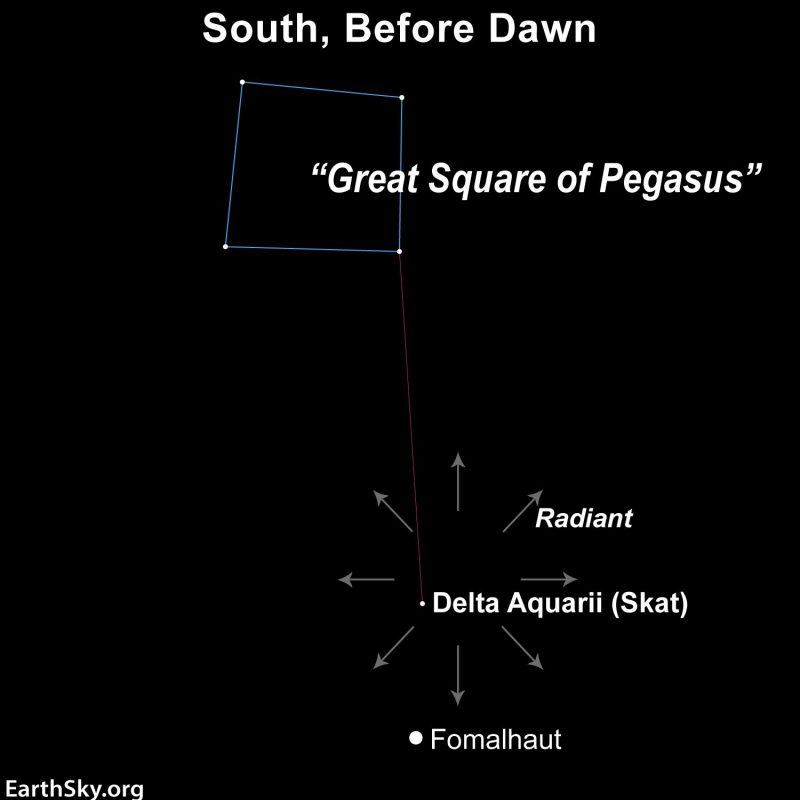
The radiant point for the Delta Aquariid meteor shower is near the faint star Skat, or Delta Aquarii. It rises in mid-evening, is highest around 2 a.m. and low in the sky by dawn. Use the bright, nearby star Fomalhaut to guide you to the Delta Aquariid radiant point. Find Fomalhaut by drawing a line southward through the stars on the west side of the Great Square of Pegasus. This chart shows a wide area, from overhead to southward, as seen from the Northern Hemisphere. From the Southern Hemisphere, the radiant is closer to overhead. In 2026, the full moon falls at 14:36 UTC on July 29. Take advantage of the moon-free mornings – after midnight – the week before for watching the Delta Aquariids (and the early Perseids).
July morning planets
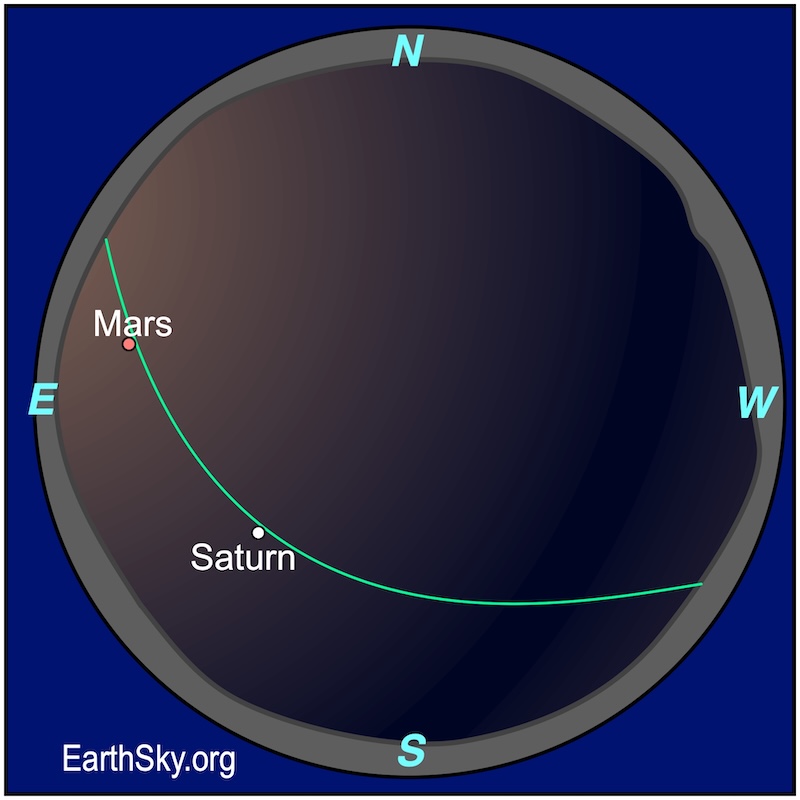
This all-sky chart shows Mars and Saturn – around the first week of July – in the east shortly before sunrise. Saturn is farther away, but it’s bigger; it’ll be the brighter of the 2 planets. Note that the planets lie along the ecliptic, the path the sun travels in the daytime (the green line on our chart). Chart via EarthSky.
Our charts are mostly set for mid-latitudes in the Northern Hemisphere. To see a precise view – and time – from your location, try Stellarium Online.
July evening planets
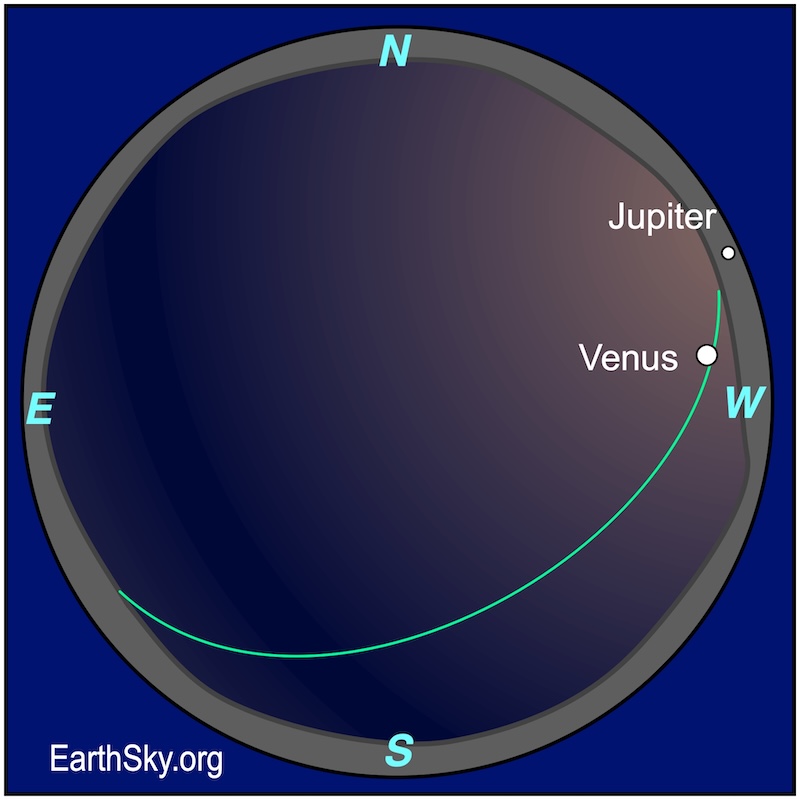
This all-sky chart shows bright Jupiter and Venus about 60 minutes after sunset, in early July. Each day, Venus will ascend higher as it races toward its greatest distance from the sun on August 14-15. Jupiter, on the other hand, has been falling quickly below the sunset horizon in the evening twilight. It’ll be most directly behind the sun from Earth on July 29. And it’ll return – to the east before dawn this time – in September. Note that planets lie along the ecliptic, the path the sun travels in the daytime (the green line on our chart). Chart via EarthSky.
Our charts are mostly set for mid-latitudes in the Northern Hemisphere. To see a precise view – and time – from your location, try Stellarium Online.
July 27 evening: Moon near Teapot
On the evening of July 27, the bright full moon, just hours past its peak, will hang near the stars of the asterism of Sagittarius called the Teapot. Chart via EarthSky.
The almost full moon will rise in the east opposite the sunset on the evening of July 28. The July full Buck Moon will occur at 14:36 UTC on July 29. That is 9:36 a.m. Central Daylight Time in the Americas. And it’s 2:36 a.m. New Zealand Standard Time on July 30. Chart via EarthSky.
Our charts are mostly set for mid-latitudes in the Northern Hemisphere. To see a precise view – and time – from your location, try Stellarium Online.
July 29 and 30 evenings: Moon and Capricornus
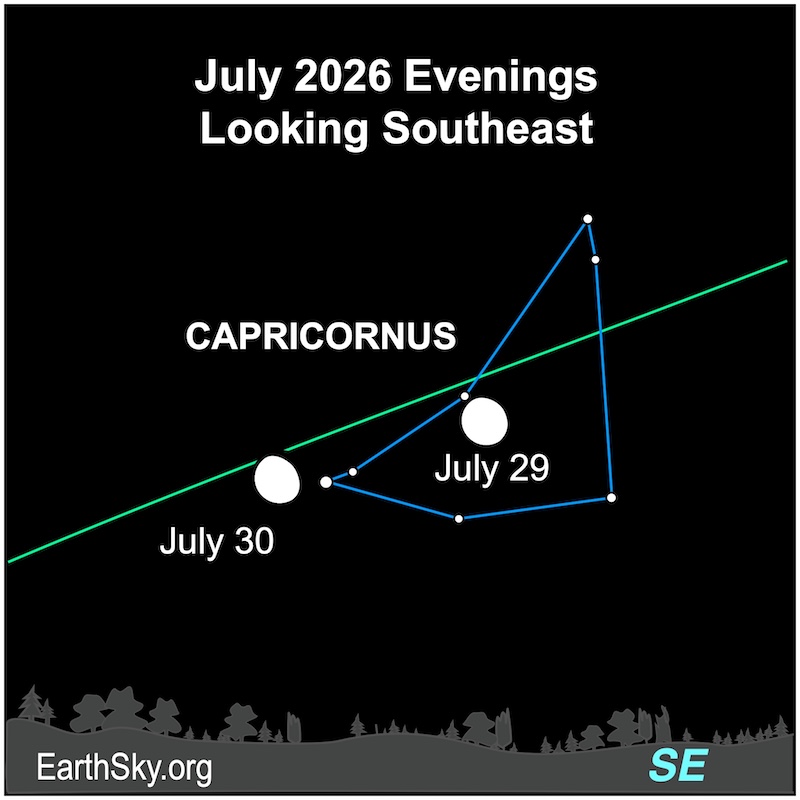
In the late evening of July 29, the bright waning gibbous moon will hang among the 7 stars of the constellation Capricornus the Sea-goat. The moon’s brightness will likely overpower the constellation. On the next evening, July 30, the moon is near the arrowhead-shaped pattern of stars making up Capricornus. Chart via EarthSky.
On August 12, 2026, the moon will pass directly in front of the sun, creating one of nature’s most breathtaking sights: a total solar eclipse. Join EarthSky’s Deborah Byrd for a preview of this extraordinary event. See where the path of totality will cross Earth and find out how long the eclipse will last, what observers can expect to see, and why total solar eclipses are among the most awe-inspiring events in the sky. Will North America be able to see it? Watch in the player above or on YouTube.
Mercury appears farthest from the sun August 2
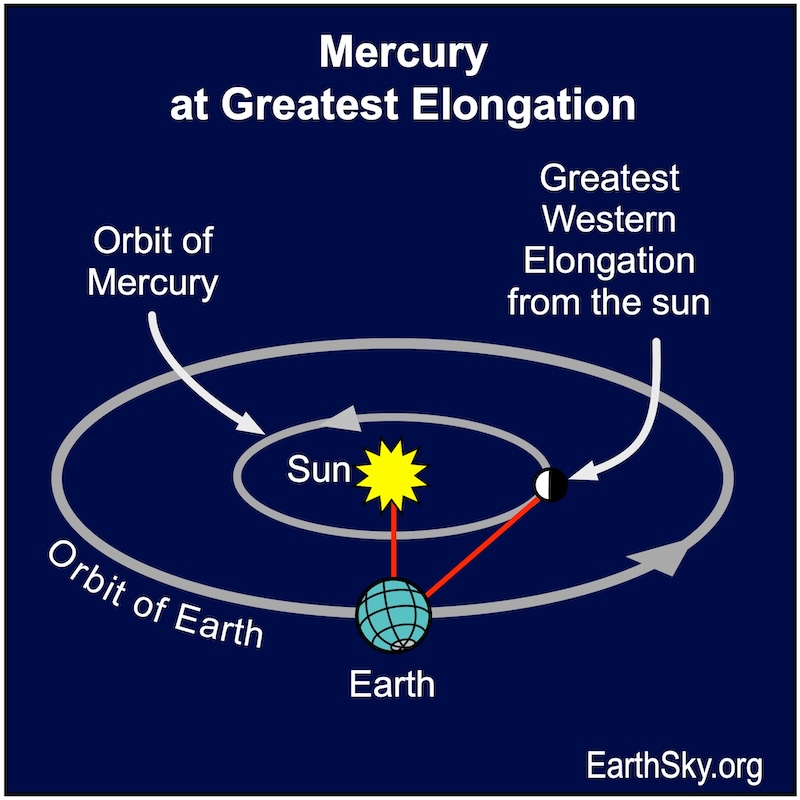
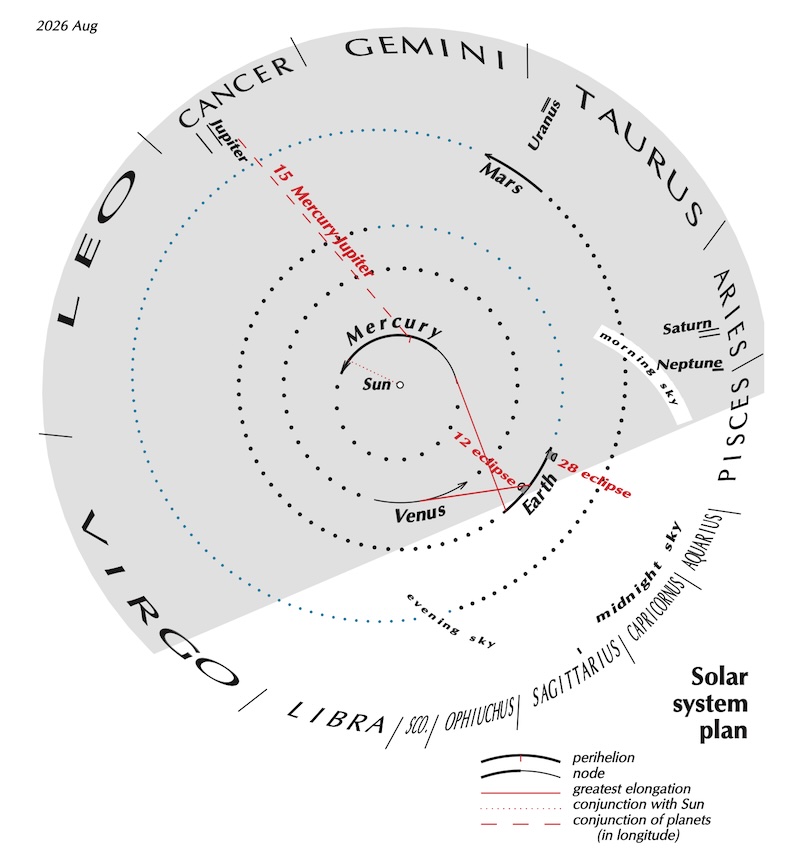
Mercury will appear farthest from the sun from our Earthly point of view at 8 UTC (3 a.m. CDT) on August 2, 2026. When Mercury appears farthest from the morning sun in the pre-dawn sky, astronomers call it greatest western elongation. This morning apparition of Mercury favors the Northern Hemisphere. Chart via EarthSky.
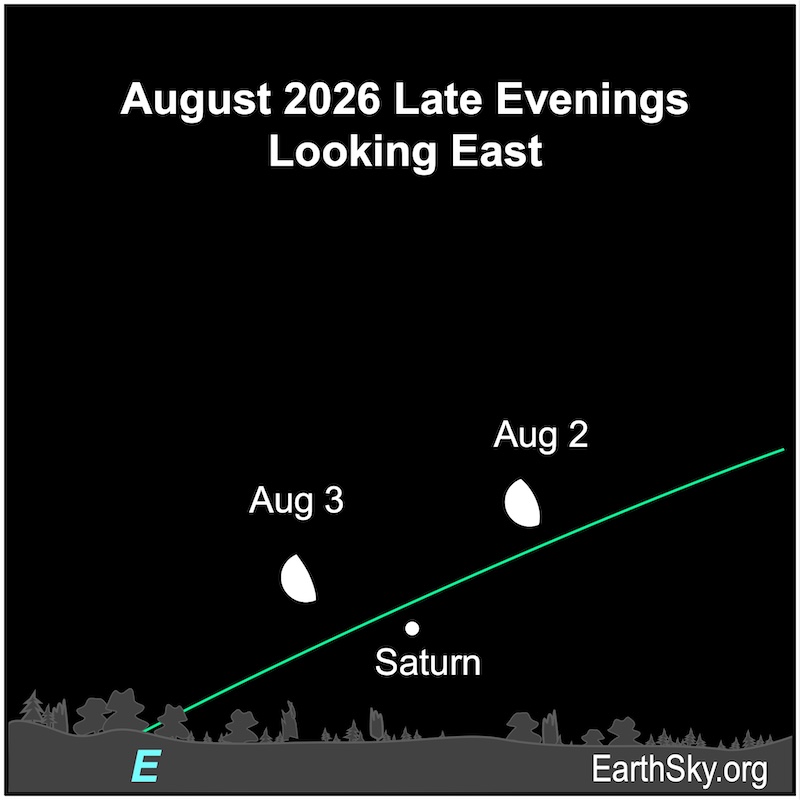
The waning gibbous moon will pass Saturn on the late evenings of August 2 and 3. They’ll be visible through dawn. Chart via EarthSky.
August morning planets: Northern Hemisphere view
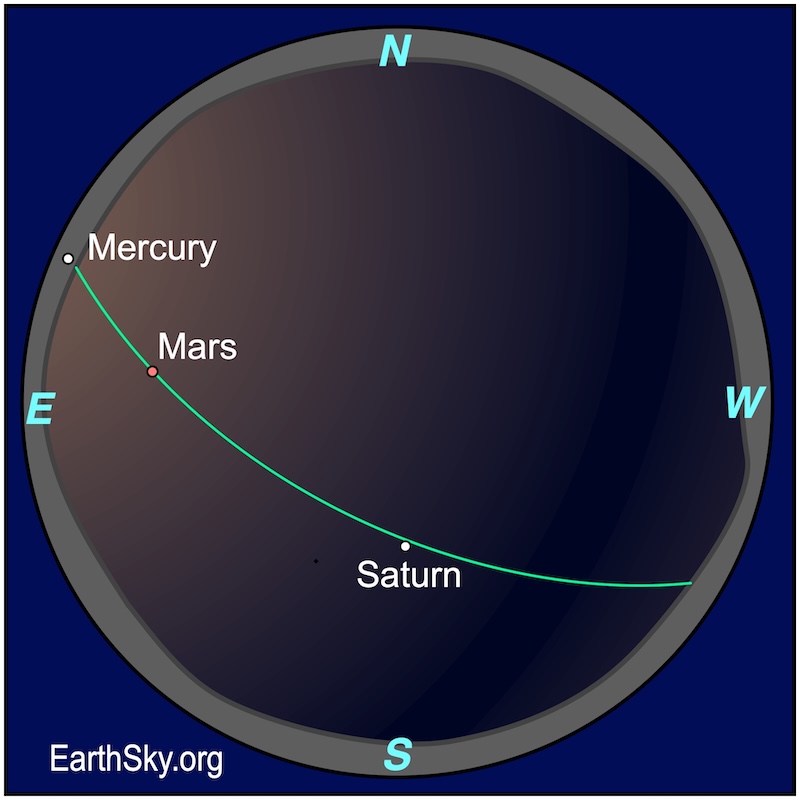
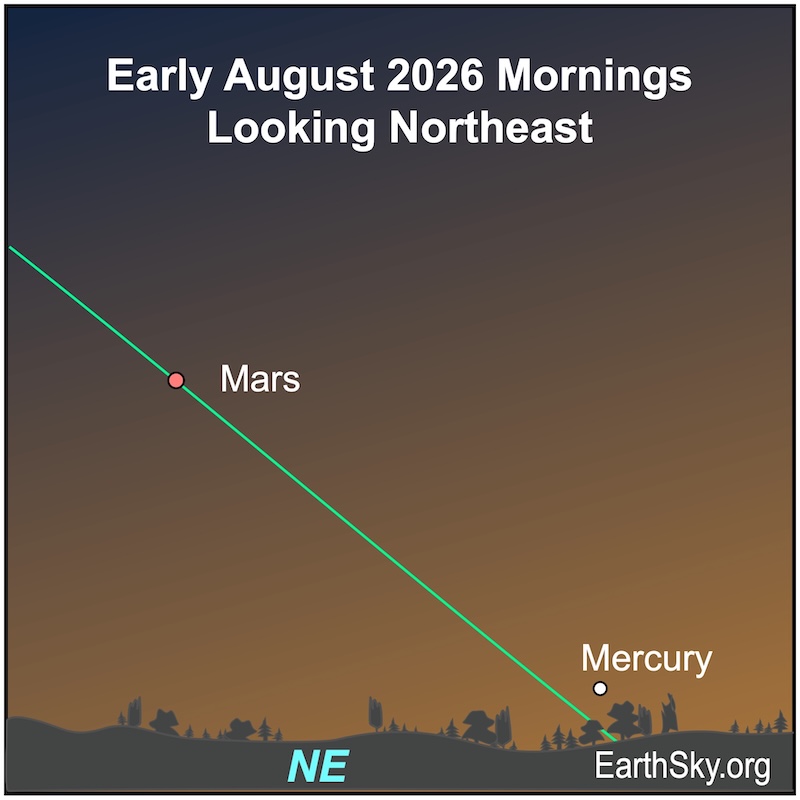
As viewed from the Northern Hemisphere, the early August morning sky features 3 bright planets: Saturn shining in the south, Mars climbing in the east, and Mercury hugging the eastern horizon. Note that these planets lie along the path the sun travels in the daytime (the green line on our chart). Chart via EarthSky.
August 5 morning: Moon near Saturn and Pleiades
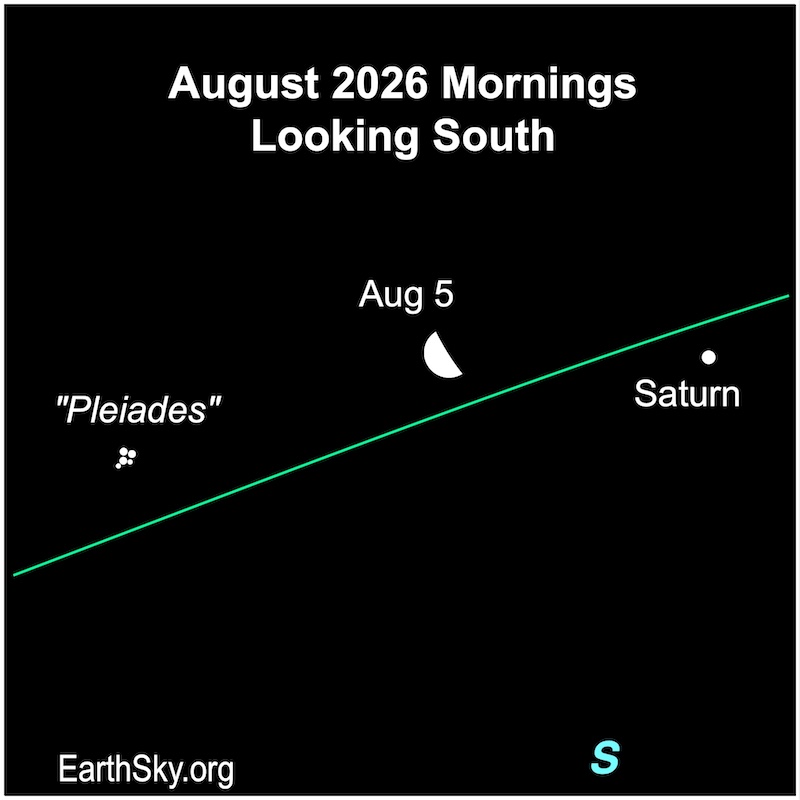
The 3rd quarter moon will lie between Saturn and the Pleiades star cluster on the morning of August 5. Chart via EarthSky.
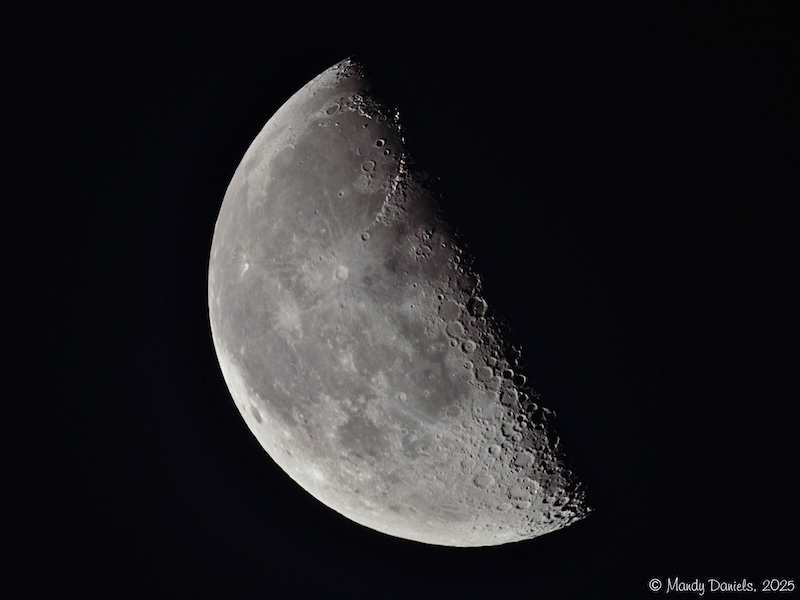
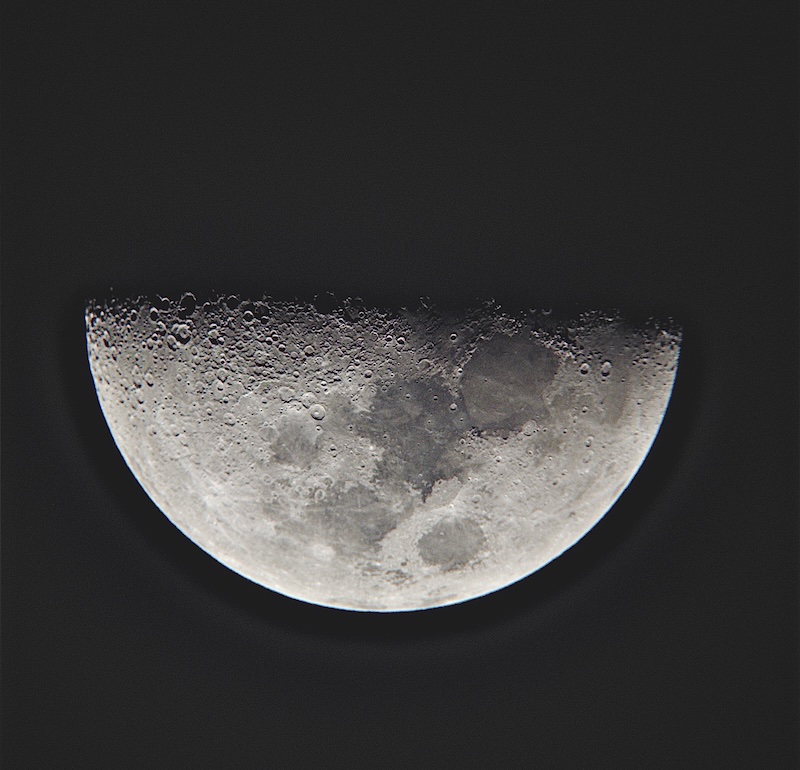
View at EarthSky Community Photos. | Mandy Daniels captured this image of the last quarter moon on September 14, 2025, in the UK. Thank you, Mandy! The moment of the 3rd quarter moon will fall at 2:21 UTC on August 6, 2026. That’s 9:21 p.m. Central Daylight Time in the Americas on August 5. And it’s 2:21 p.m. New Zealand Standard Time. It’ll rise in the middle of the night and set around midday. Look for it high in the sky before dawn.
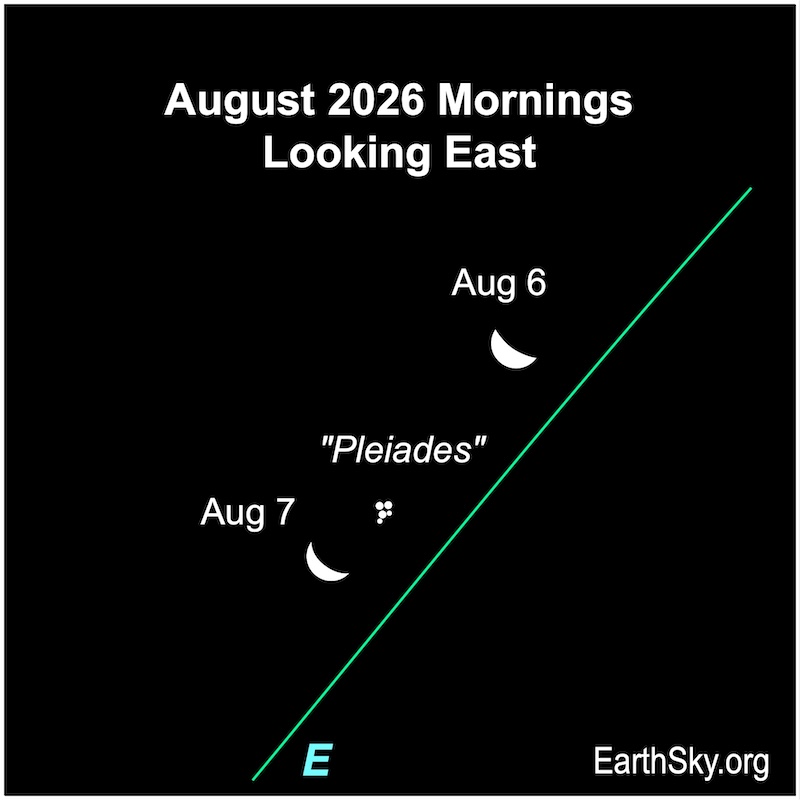
The thick waning crescent moon will approach and pass the Pleiades star cluster in the early morning hours of August 6 and 7. Chart via EarthSky.
August 8 and 9: Moon visits a trio of bright stars and Mars
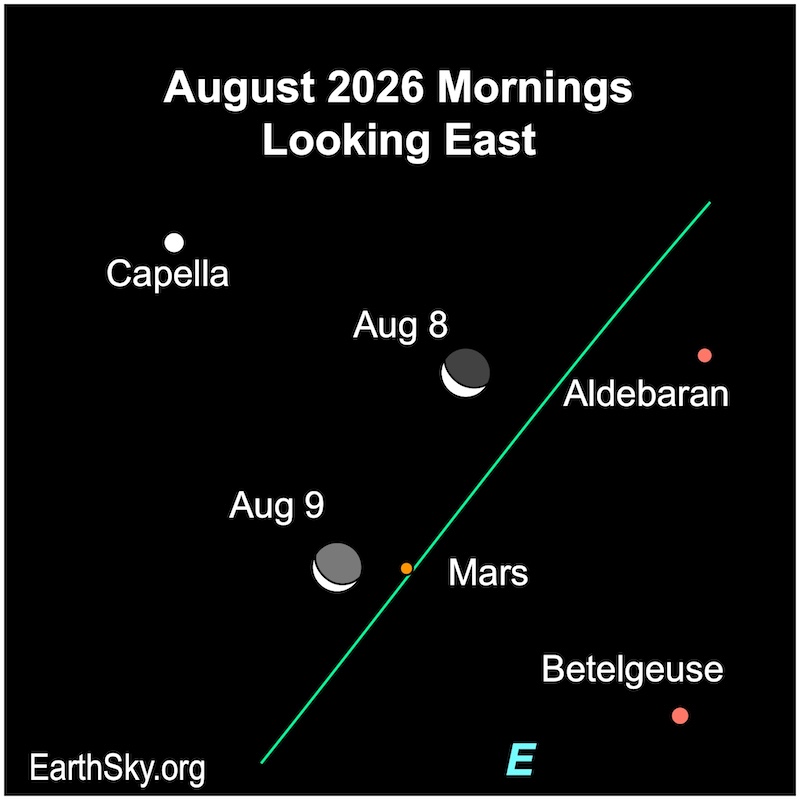
In the early morning hours on August 8 and 9, the waning crescent moon will move among the bright stars Capella, Aldebaran and Betelgeuse. The red planet Mars is there too. On the morning of August 9, the moon will lie close to Mars. Chart via EarthSky.
August 10 and 11 mornings: Moon near twin stars and Mars
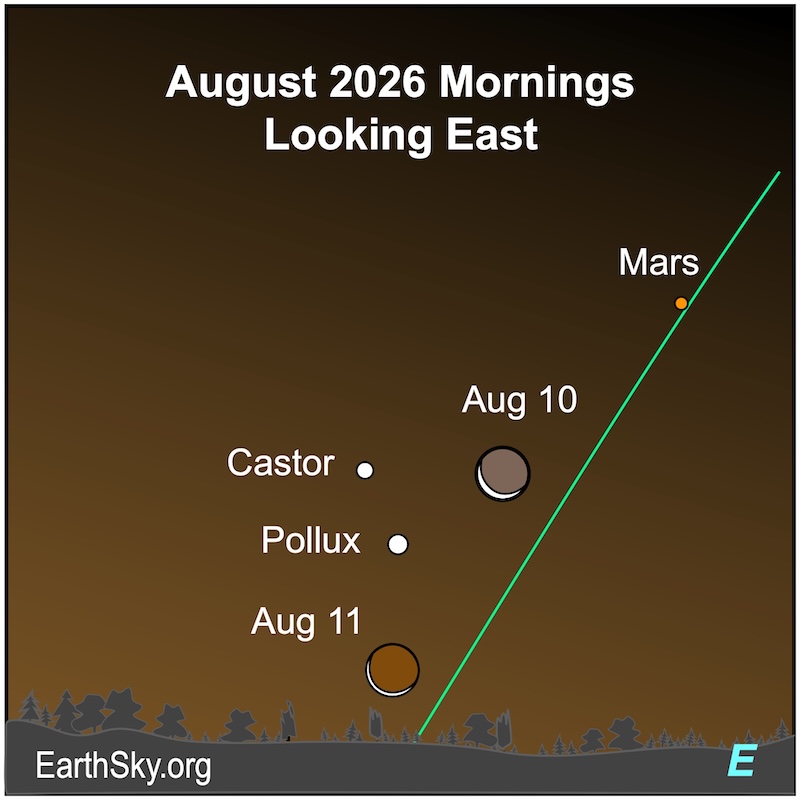
In the morning hours on August 10 and 11, the thin waning crescent moon will float near the red planet Mars. They’ll also be near the twin stars of Gemini, Castor and Pollux (the brighter of the pair). Chart via EarthSky.
Our charts are mostly set for mid-latitudes in the Northern Hemisphere. To see a precise view – and time – from your location, try Stellarium Online.
Total solar eclipse August 12
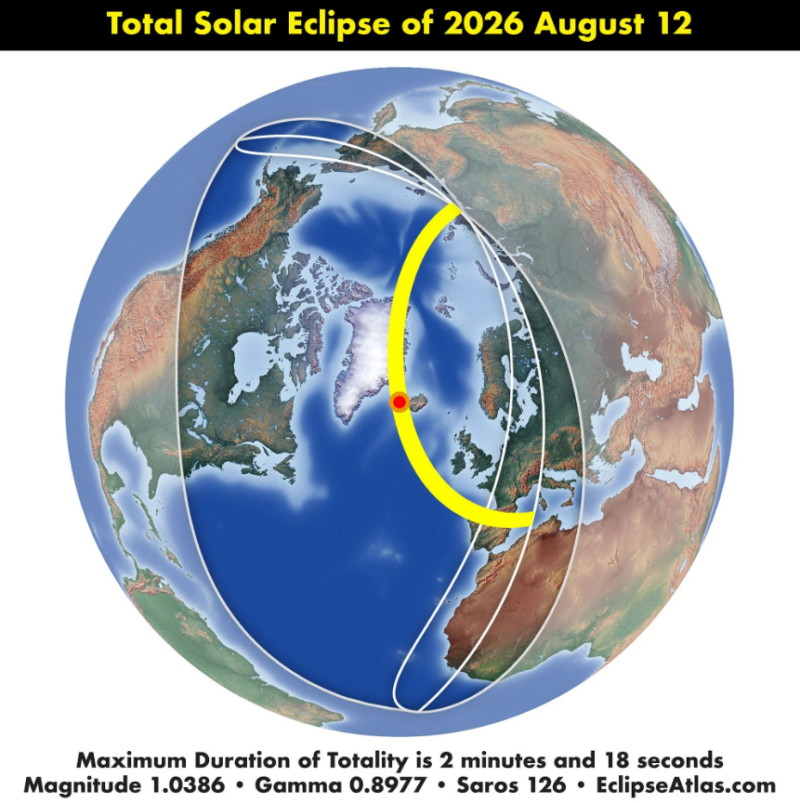
If you’re lucky enough to be in parts of Greenland, Iceland and Spain on August 12, 2026, you will be treated to a total solar eclipse. Areas outside the path will see a partial solar eclipse, including viewers in the upper Midwest and northeastern United States. Remember that for a partial solar eclipse, you must wear approved, safe solar eclipse glasses. If you’re watching the total solar eclipse, you might even see a Perseid meteor zip by! More on the Perseids below. Image via Michael Zeiler’s EclipseAtlas.com.
This GOES-19 CORR1 coronagraph from November 18-19, 2025 (designed to show coronal mass ejections from the sun), captured a fun view of the new moon, which would normally not be visible from Earth during this phase. This year’s August new moon brings us a total solar eclipse. The moment of new moon will fall at 17:37 UTC on August 12, 2026. That’s 12:37 p.m. Central Daylight Time in the Americas. And it’s 5:37 a.m. New Zealand Standard Time on August 13. New moons rise and set with the sun. Nights around the new moon offer the darkest skies. See EarthSky’s best places to stargaze. Images via NOAA/ GOES.
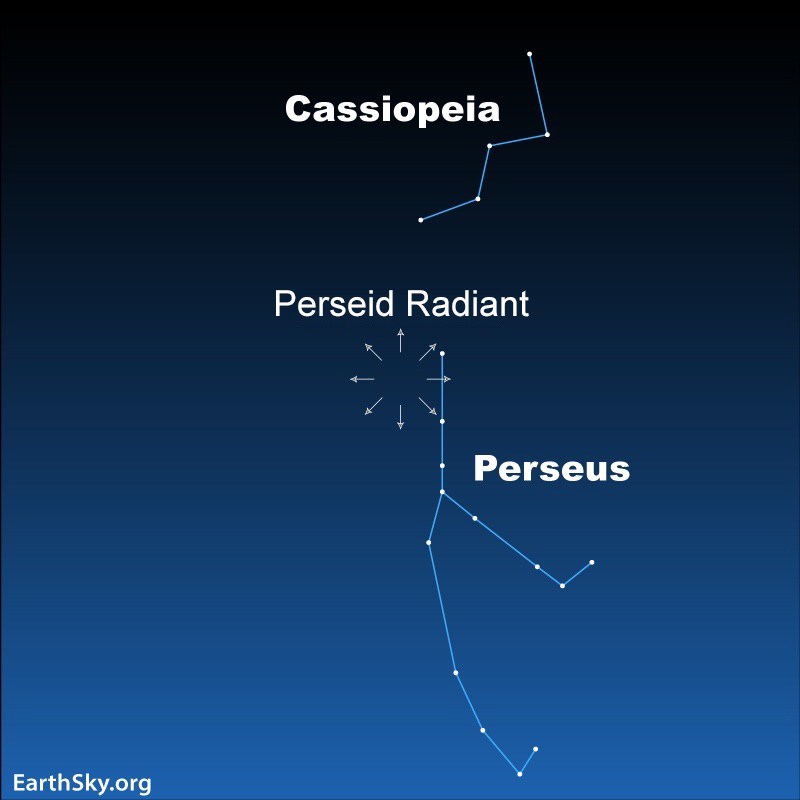
In 2026, the best time to watch the Perseid meteor shower is the after midnight through dawn on the mornings of August 12 and 13. You’ll have dark skies for meteor viewing. And since the Perseids are often bright meteors, you might see up to 90 meteors per hour. Remember, even one bright meteor can make your night! The Perseids’ radiant point rises late in the evening, around 11 p.m. your local time, nearly due northeast in the constellation Perseus. That’s why Perseids are best viewed from midnight to dawn. The greatest number of meteors are always visible after the radiant rises. You’ll see the most meteors just before dawn, when the radiant is high in the sky. But don’t just stare toward the radiant point. The meteors can appear anywhere in the sky.
August 14-15: Moon visits Venus as it reaches farthest from the sun
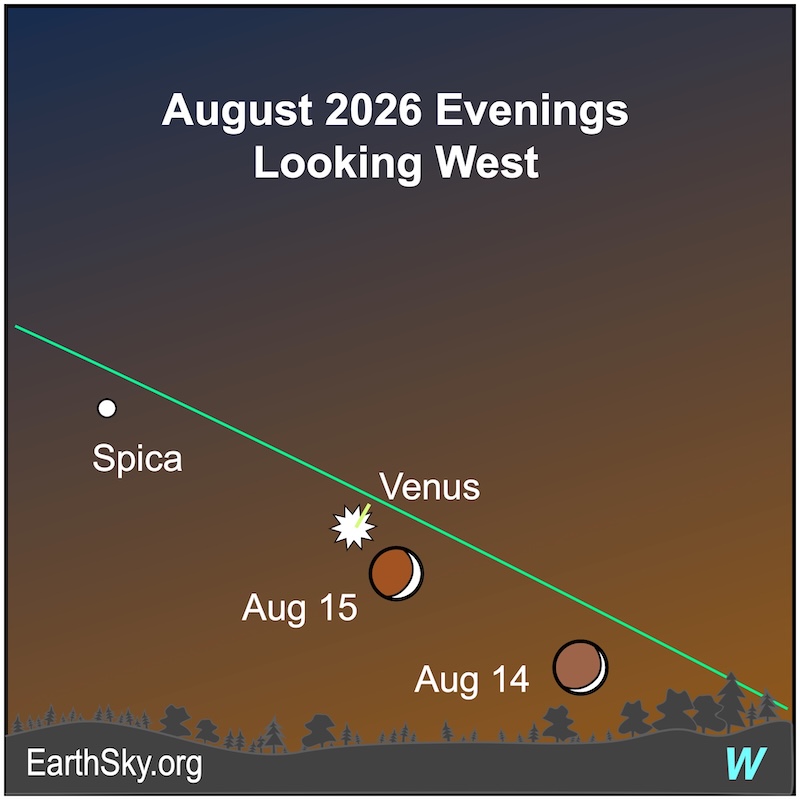
The moon and Venus – Earth’s brightest neighboring planet – will be shining in the western twilight after sunset on August 14 and 15. You can’t miss Venus! It’s exceedingly bright and will penetrate the bright twilight. It’ll remain visible in the evening sky through October. Greatest elongation – when Venus will reach its farthest distance from the sunset – is at 6 UTC on August 15, 2026. And shortly after sunset on August 14, the very thin waxing crescent moon will float above the western horizon, with Venus shining nearby in the twilight. On the following evening, August 15, the crescent moon, glowing with earthshine, will lie close to brilliant Venus. Virgo’s bright star, Spica will be nearby. Chart via EarthSky.
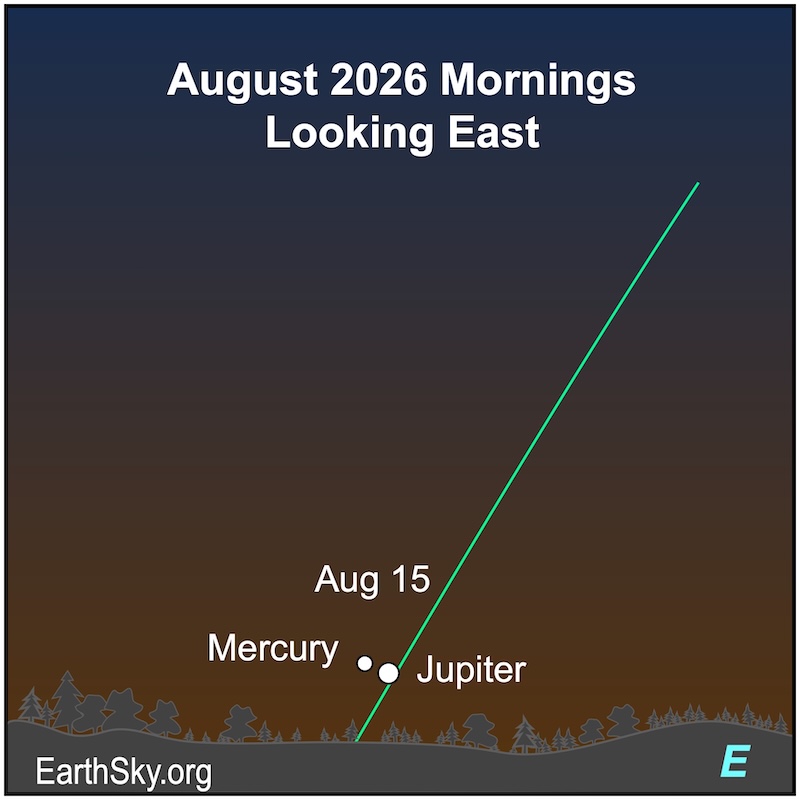
August 15 morning: Close conjunction of Jupiter and Mercury
Shortly before sunrise on August 15, Jupiter and Mercury will pass close to one another – only about one full moon width apart – in the bright morning twilight. They will be positioned very close to the eastern horizon, so a low, clear horizon line will be necessary to spot them. Chart via EarthSky.
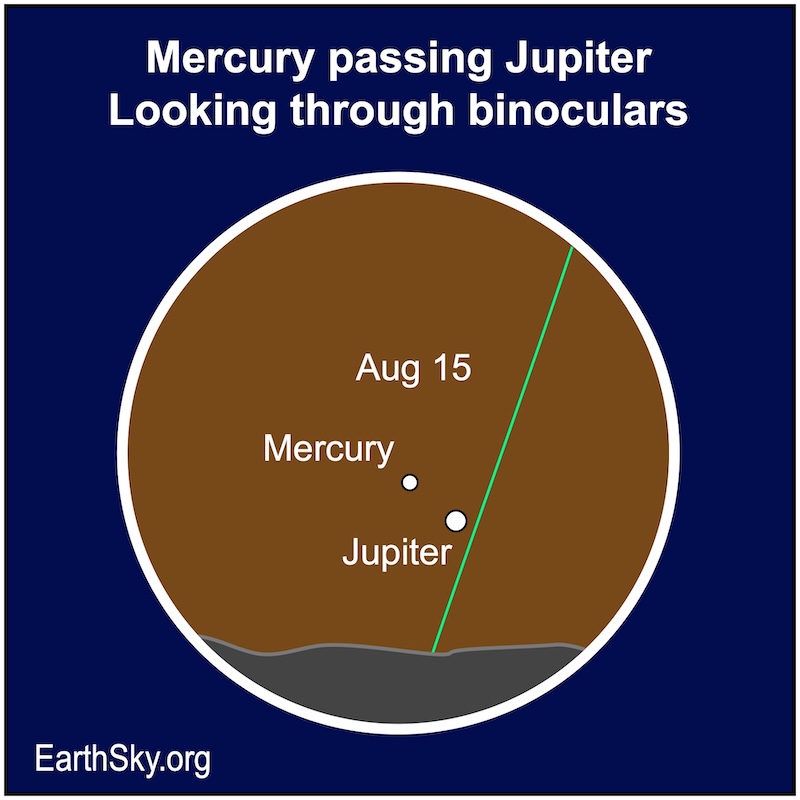
August 15 morning: Binocular view of Jupiter and Mercury
Here’s a binocular view of Mercury and Jupiter in the morning twilight before sunrise on August 15. The planets are easily separated in the bright morning twilight. Chart via EarthSky.
Our charts are mostly set for mid-latitudes in the Northern Hemisphere. To see a precise view – and time – from your location, try Stellarium Online.
August 16 and 17 evenings: Moon near Venus and Spica
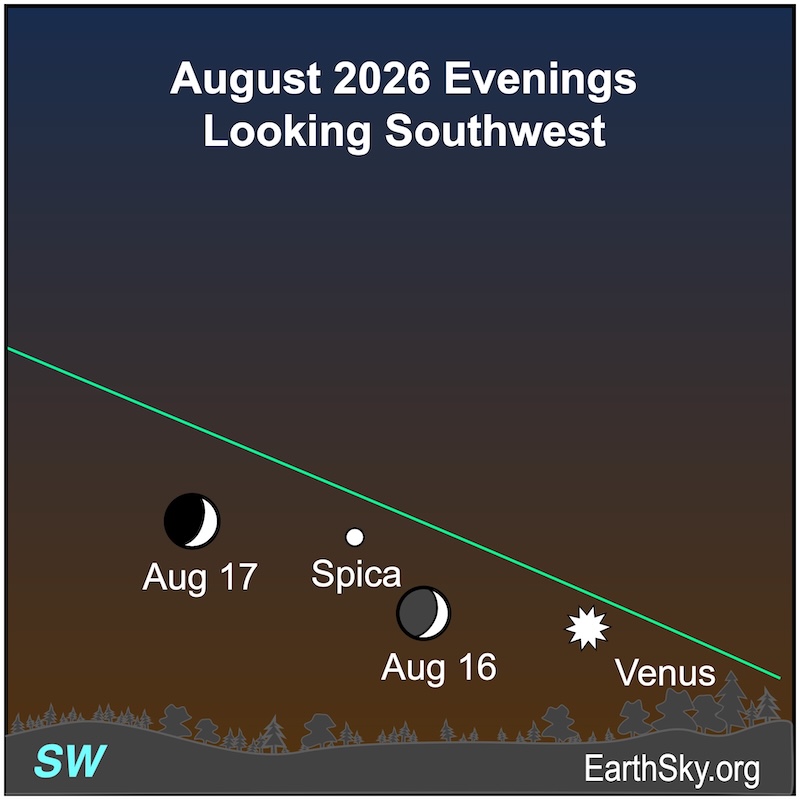
The waxing crescent moon will hang between brilliant Venus and the bright star Spica on the evening of August 16. The following night will find the moon moving away from the planet and the bright star. Spica is the brightest star in the constellation of Virgo the Maiden. They’ll set after darkness falls. Chart via EarthSky.
Our charts are mostly set for mid-latitudes in the Northern Hemisphere. To see a precise view – and time – from your location, try Stellarium Online.
August 20: 1st quarter moon
View at EarthSky Community Photos. | Amol Gaikaiwari took this picutre on May 23, 2026, in India and wrote: “The moon was in its first quarter phase. It was roughly 51% illuminated, with half of the lunar disk brightly lit against the night sky.” Thank you, Amol! This month’s moment of 1st quarter moon will fall at 2:46 UTC on August 20, 2026. That’s 9:46 p.m. Central Daylight Time in the Americas on August 19. And it’s 2:46 p.m. New Zealand Standard Time. A 1st quarter moon rises around noon your local time and sets around midnight. Watch for a 1st quarter moon high in the sky at sundown.
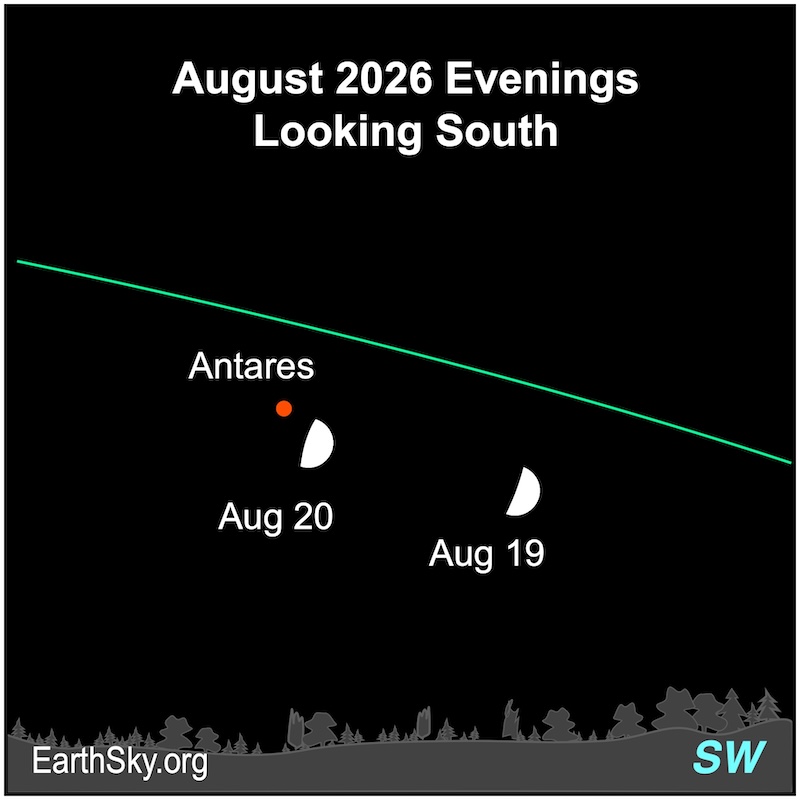
The 1st quarter moon will lie near the brightest star in Scorpius the Scorpion, Antares, on the evening of August 19. Then, on the next night, the moon floats even closer to Antares. They’ll set around the middle of the night. Chart via EarthSky.
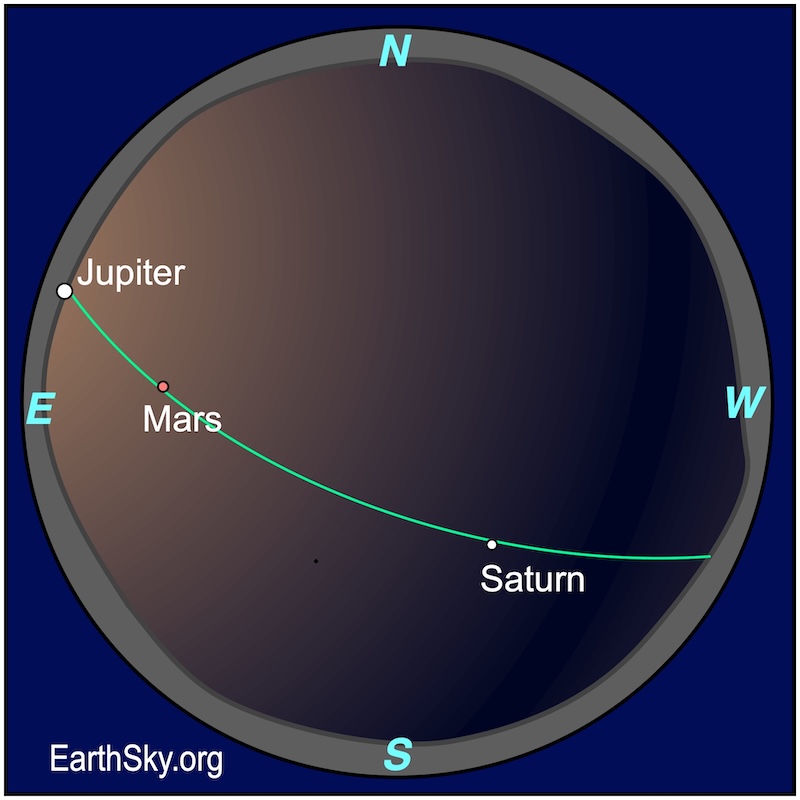
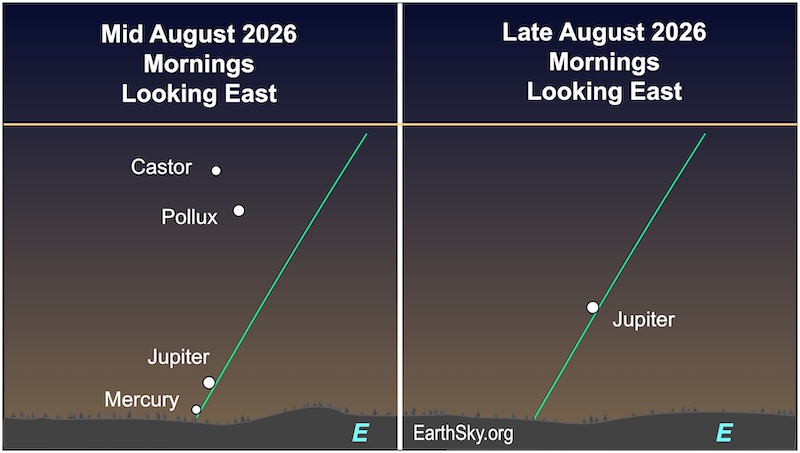
As viewed from the Northern Hemisphere, the late August morning sky will feature 3 bright planets: Saturn shining in the south, Mars climbing in the east, and Jupiter hugging the eastern horizon. Note that these planets lie along the path the sun travels in the daytime (the green line on our chart). Chart via EarthSky.
August 21: Moon hangs with Scorpius
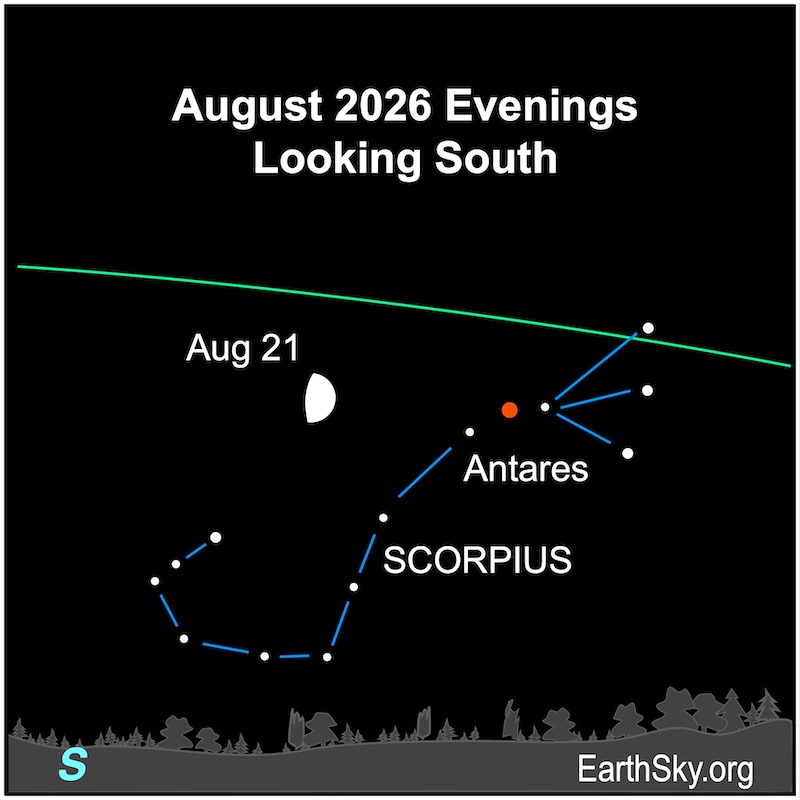
The waxing gibbous moon will sit in the middle of the “J” shaped constellation, Scorpius the Scorpion. It will also lie near its brightest star, Antares. They’ll set around the middle of the night. Chart via EarthSky.
August 22 and 23 evenings: Moon near Teapot
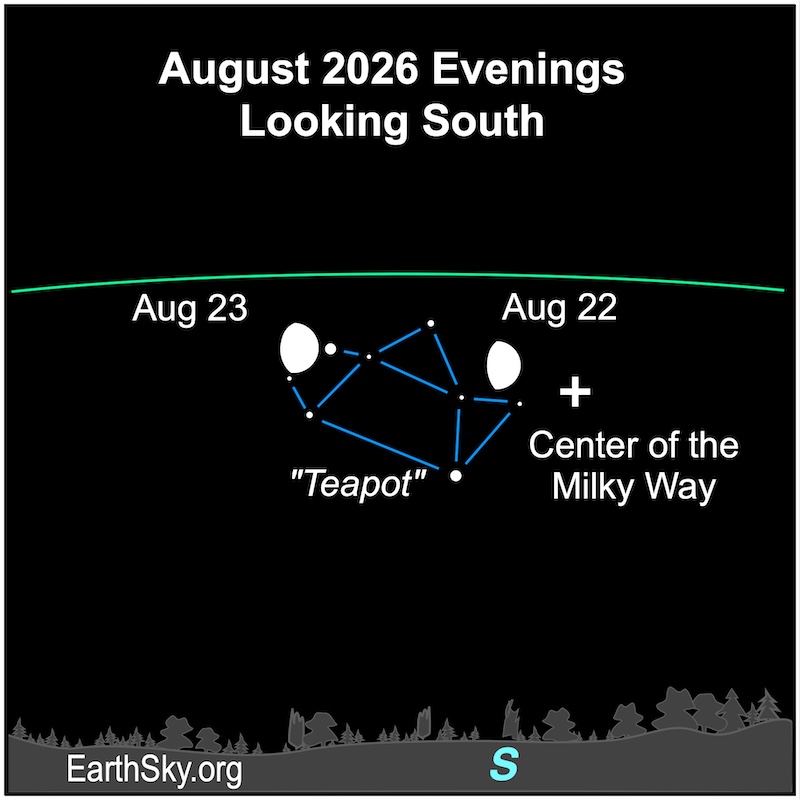
The bright waxing gibbous moon will pass in the front of the Teapotasterism of Sagittarius on the evenings of August 22 and 23. On the first evening, it sits near the direction of the center of the Milky Way galaxy. Block out the moon’s light to help spot some of the stars of the Teapot. They’ll set after the middle of the night. Chart via EarthSky.
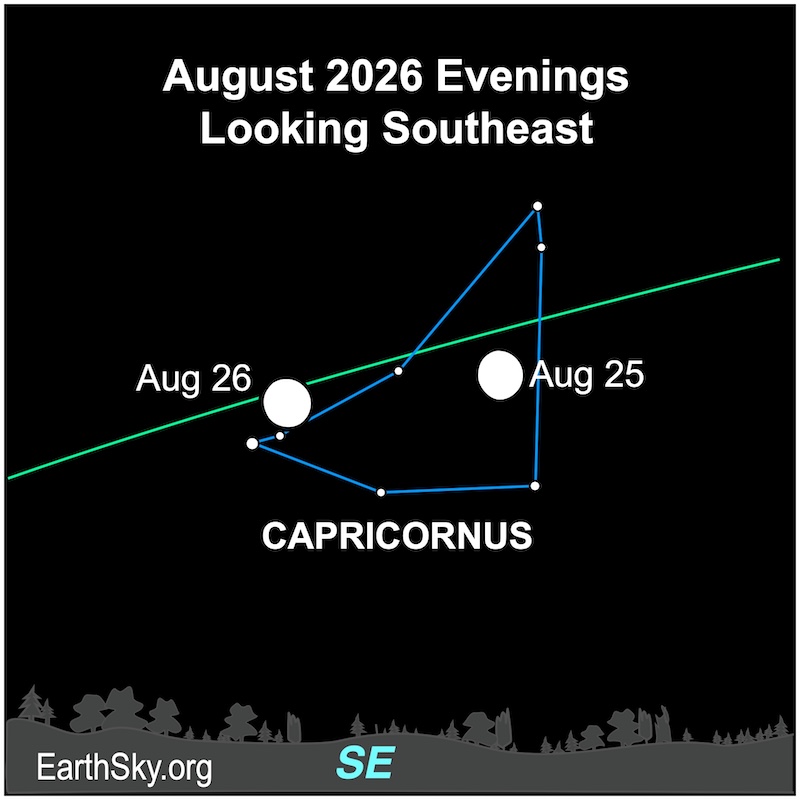
The bright waxing gibbous moon will pass through the arrowhead shape of Capricornus the Sea-goat on the evenings of August 25 and 26. Try to block out the moon to see some of the stars of the “arrowhead” shape. You can catch them until around dawn. Chart via EarthSky.
Deep partial eclipse overnight on August 27-28
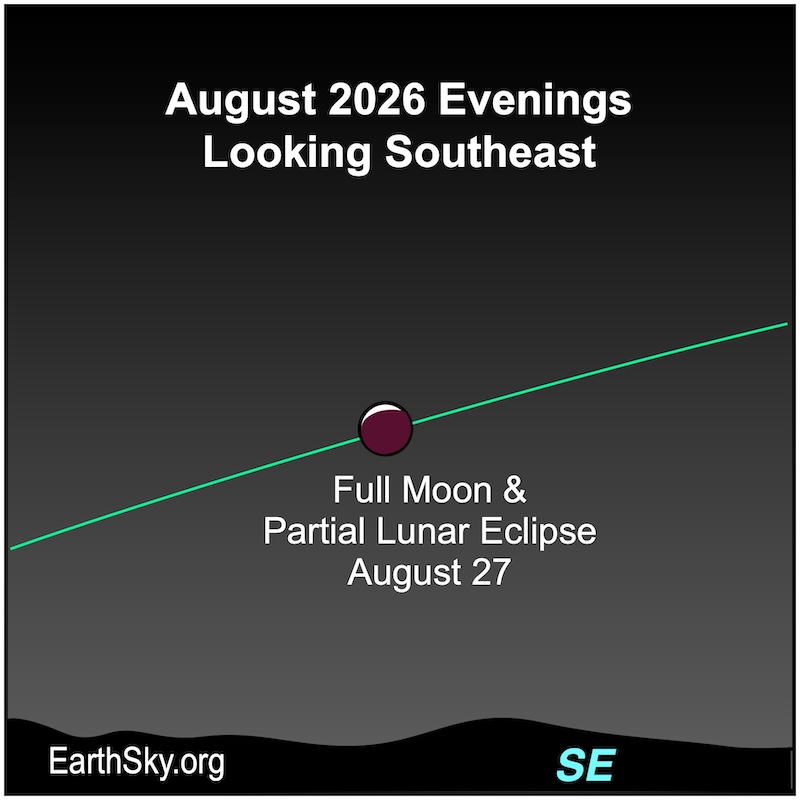
As twilight darkens in the west on August 27, the full Sturgeon Moon will glow brightly in the east. It undergoes a wonderful and dramatic partial lunar eclipse that night. The eclipse will be visible in Africa, Europe, Scandinavia, Iceland, parts of Greenland, Antarctica, most of the Americas and eastern Pacific Ocean. Chart via EarthSky.
Our charts are mostly set for mid-latitudes in the Northern Hemisphere. To see a precise view – and time – from your location, try Stellarium Online.
August 29 and 30 evenings: Moon near Saturn
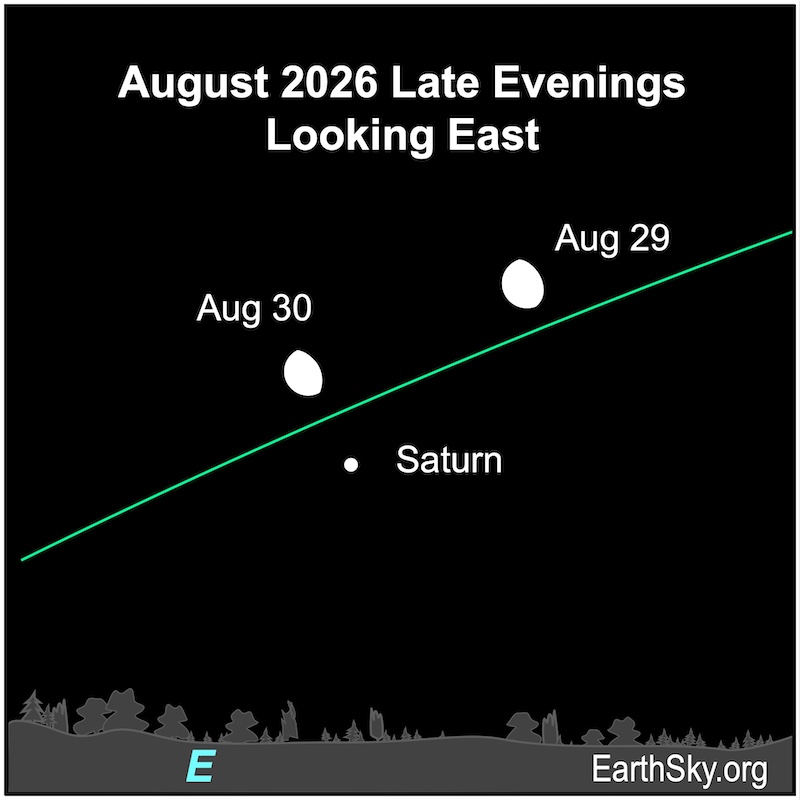
The waning gibbous moon joins Saturn on the evenings of August 29 and 30. You can catch them until dawn. Chart via EarthSky.
More about the July evening planet
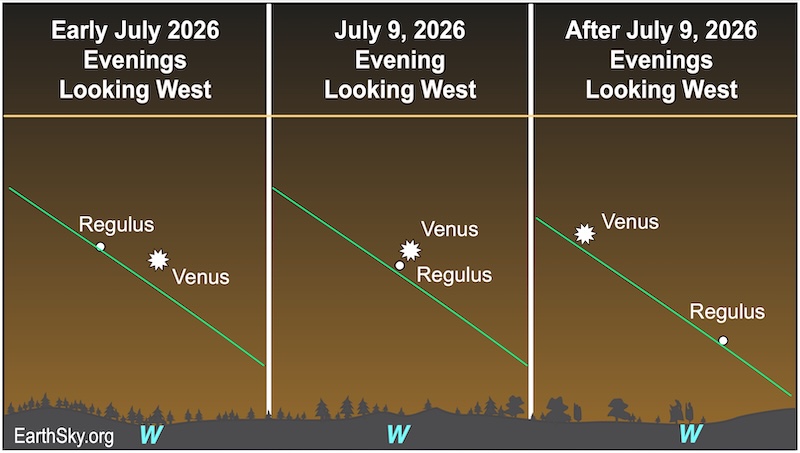
Bright Venus will rise slightly higher shortly after sunset each evening all month. It will pass the star Regulus on July 9, then they’ll drift apart. Venus will ascend higher each night as it races toward its greatest distance from the sun on August 14-15. Chart via EarthSky.
More about July morning planets
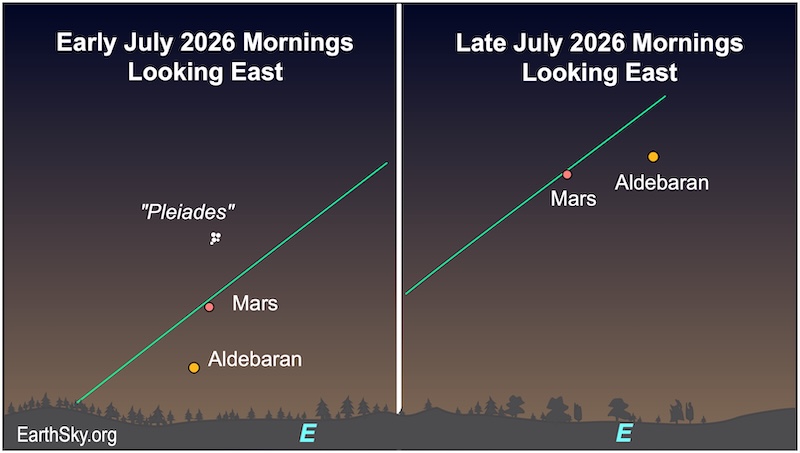
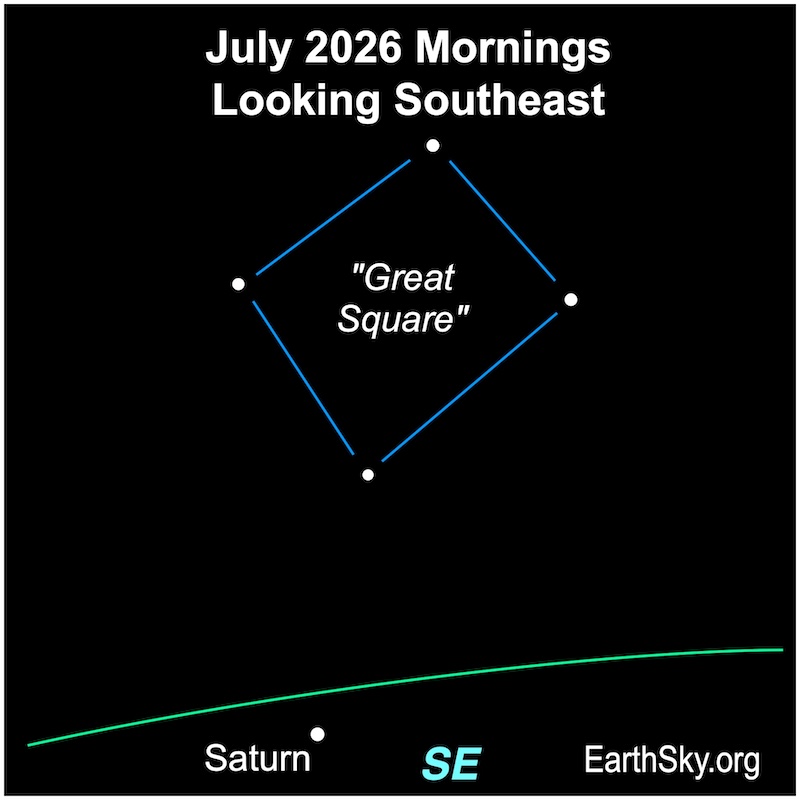
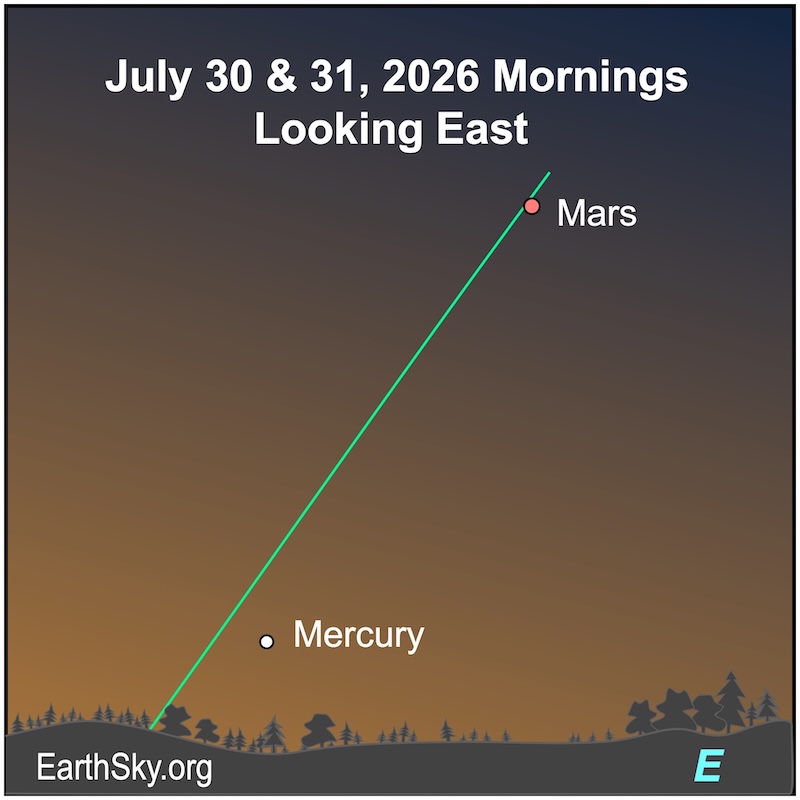
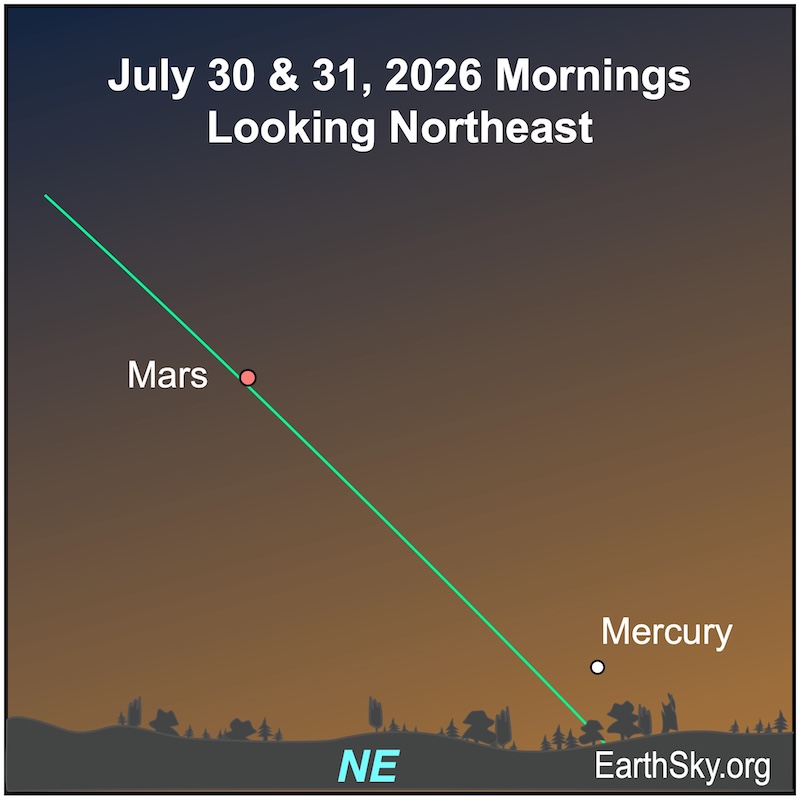
In the first half of July, Mars will lie low in the bright eastern twilight shortly before sunrise. It slides between the Pleiades star cluster and the bright star Aldebaran. In the second half of the month, Mars will rise higher while moving past Aldebaran. Chart via EarthSky.Saturn will lie in the south in the early morning hours of July. It’s the bright object to the lower left of the 4 moderately bright stars that comprise the Great Square asterism. Chart via EarthSky.From the Northern Hemisphere, on the last 2 mornings of July, Mercury will shine low in the east in the bright twilight. Higher in the sky is the red planet Mars. Mercury will reach its greatest distance from the sun on the morning of August 2. Chart via EarthSky.For Southern Hemisphere viewers, Mercury will lie low in the east during the last 2 mornings of July. Also, look for Mars higher in the sky. Mercury will reach its greatest distance from the sun on the morning of August 2. Chart via EarthSky.
August evening planet
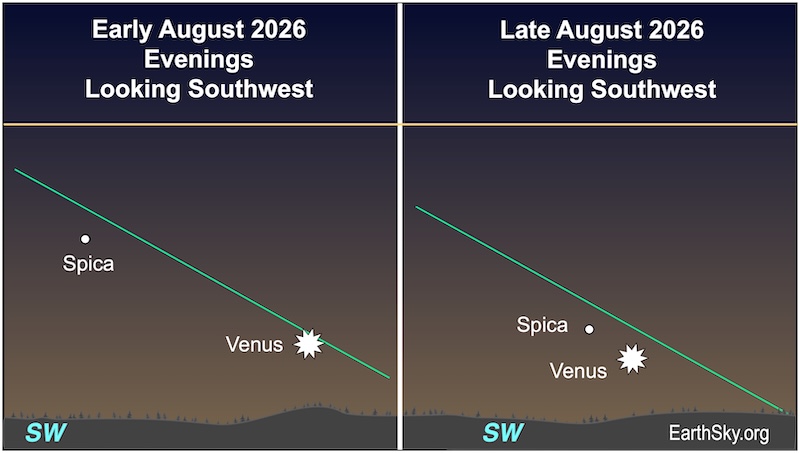
In early August shortly after sunset, brilliant Venus will lie low in the west. To its upper left is Spica, the brightest star in Virgo. By month’s end, Spica will have dropped much closer to Venus. Venus will reach its greatest distance from the sun on August 14-15. Chart via EarthSky.
August morning planets
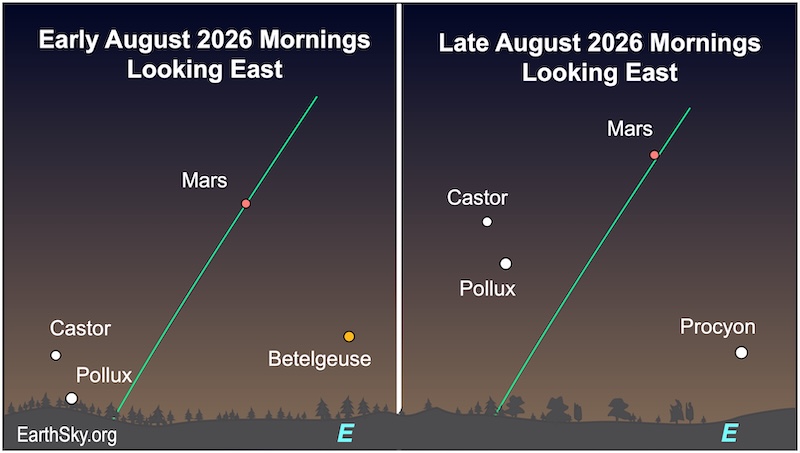
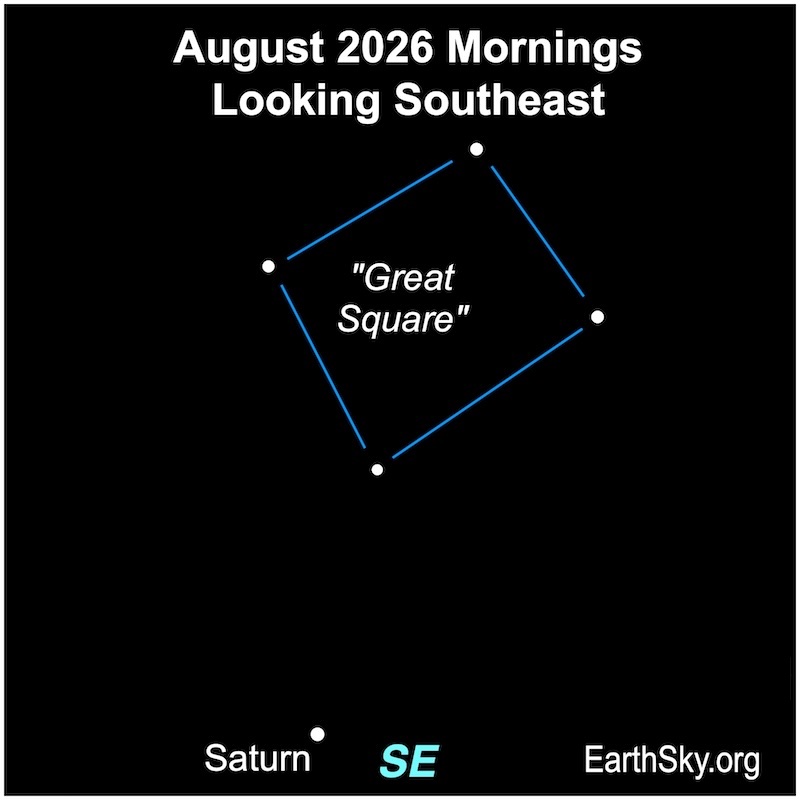
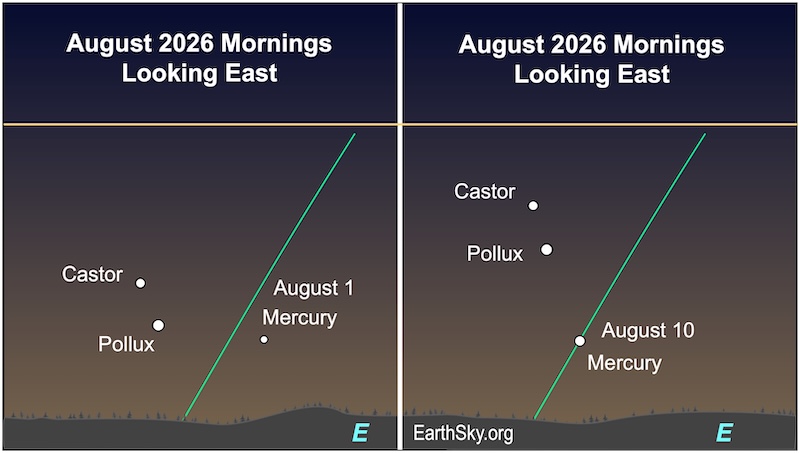
In the first half of August, Mars will rise out of the morning twilight and will lie near the star Betelgeuse and the twin stars of Gemini, Castor and Pollux. In the second half of the month, Mars along with Castor and Pollux have climbed above the horizon. And the bright star Procyon joins them above the eastern horizon. Chart via EarthSky.Jupiter will appear in the bright morning twilight before sunrise around August 12, with Mercury nearby. After August 15, for a few days, Mercury can be seen below Jupiter before disappearing in the bright morning twilight. Then during the second half of the month, Jupiter steadily climbs higher each morning. Chart via EarthSky.Saturn will lie in the southeast in the early morning hours in August. It’s the bright object to the lower left of the 4 moderately bright stars that comprise the Great Square asterism. Chart via EarthSky.From the Northern Hemisphere, on the first few mornings of August, Mercury will be near the twin stars of Gemini, Castor and Pollux. By August 10, Mercury will brighten and lie below them, forming a straight line with the twin stars. Chart via EarthSky.For Southern Hemisphere viewers, Mercury will lie low in the northeast during the first week of August. And Mars is to its upper left. Chart via EarthSky.
July stars
If you’re out stargazing on any July evening, look for these stars and constellations overhead in the sky.
Hercules the Hero and the Hercules Cluster
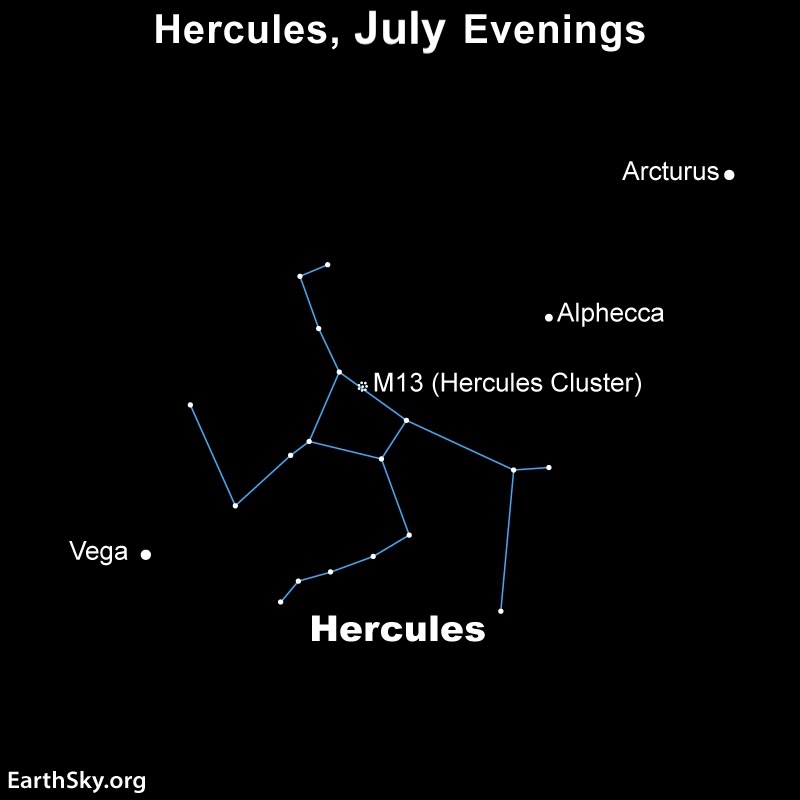
Hercules is a faint constellation. But its midsection contains the easy-to-see Keystone asterism. You can find Hercules between the bright stars Vega in Lyra the Harp and Arcturus in Boötes the Herdsman. And once you find the Keystone, you can easily locate M13, the Hercules cluster. Chart via EarthSky.
Lyra the Harp
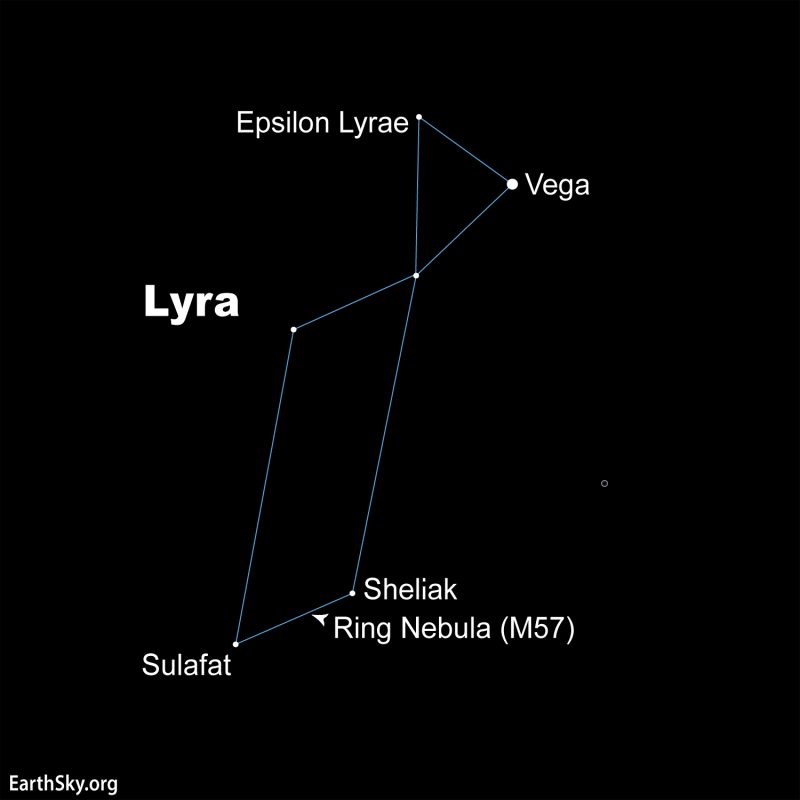
The constellation Lyra the Harp is made of a triangle and a parallelogram. Its brightest star is Vega. Next to it, look for Epsilon Lyrae, the famous Double Double star. Chart via EarthSky.
Cygnus the Swan
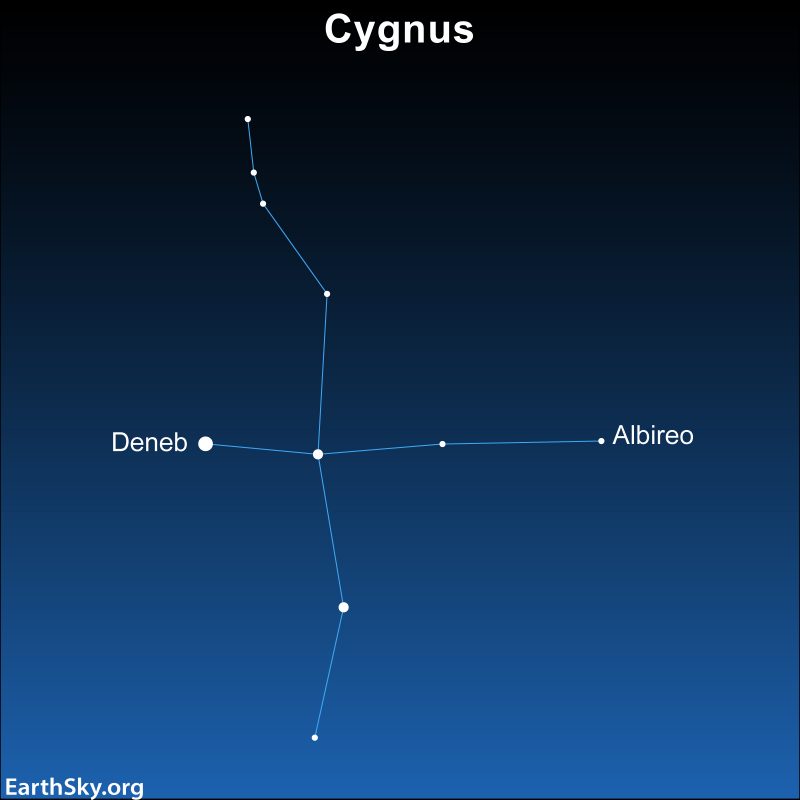
Cygnus the Swan’s brightest star, Deneb, marks one of the corners of the Summer Triangle. And its bright double star, Albireo, is one of the finest in the heavens.
If you’re out stargazing on any August evening, look for these stars and constellations overhead in the evening sky.
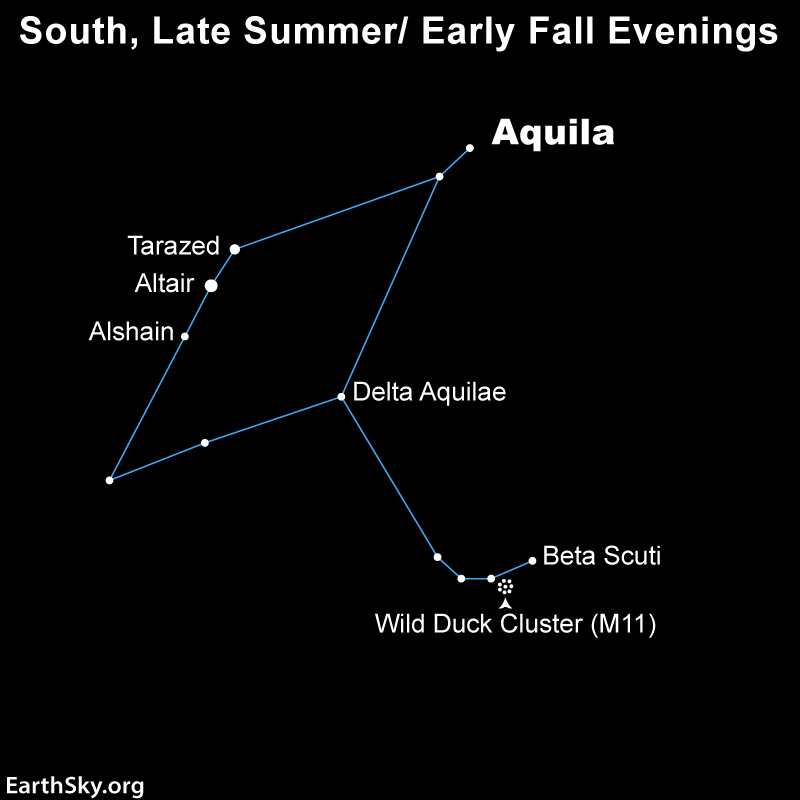
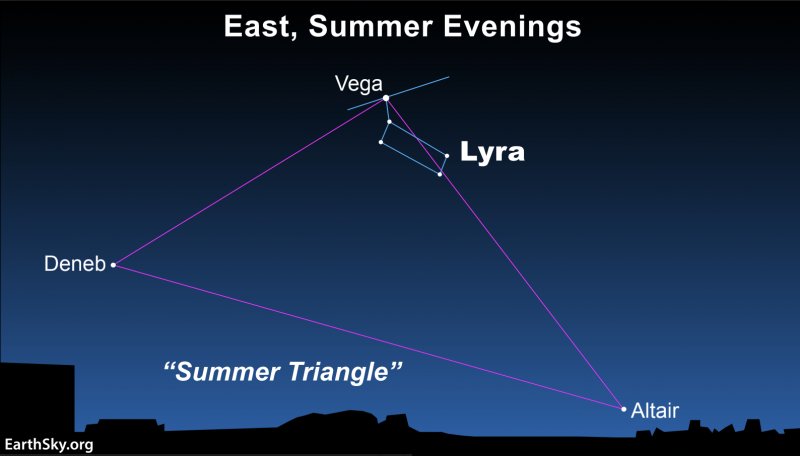
If you have a dark sky, it’s easy to observe the edgewise view into our own galaxy – our Milky Way – spanning across the heavens. Need help finding it? Look toward the constellation Cygnus the Swan. You might know this constellation by its asterism, the Northern Cross. The Swan swims along the Milky Way. Its brightest star is Deneb, the Swan’s Tail. Additionally, the constellation Cygnus contains one of the most beloved double stars in the sky, Albireo, which appears blue and gold.The constellation Lyra the Harp is another summer favorite. It consists of a triangle and a parallelogram. Its brightest star is Vega. Then, look next to it for the famous Double Double Star, Epsilon Lyrae,. It’s really 4 stars in all.Aquila the Eagle is home to the star Altair, which is one of the corners of the Summer Triangle. In addition, you can also use Aquila to starhop your way to the Wild Duck Cluster in Scutum. Image via EarthSky.This chart shows the 3 stars of the Summer Triangle in the evening sky, looking east. Note the size of Vega’s constellation, Lyra. So the Summer Triangle is big! A 12-inch (1/3-meter) ruler, placed at an arm’s length from your eye, will span the approximate distance from Vega to the star Altair. And an outstretched hand with thumb and pinky spread will fill the gap between Vega and Deneb. You can see the Summer Triangle in the evening from around May through the end of every year.
Our charts are mostly set for the northern half of Earth. To see a precise view – and time – from your location, try Stellarium Online.
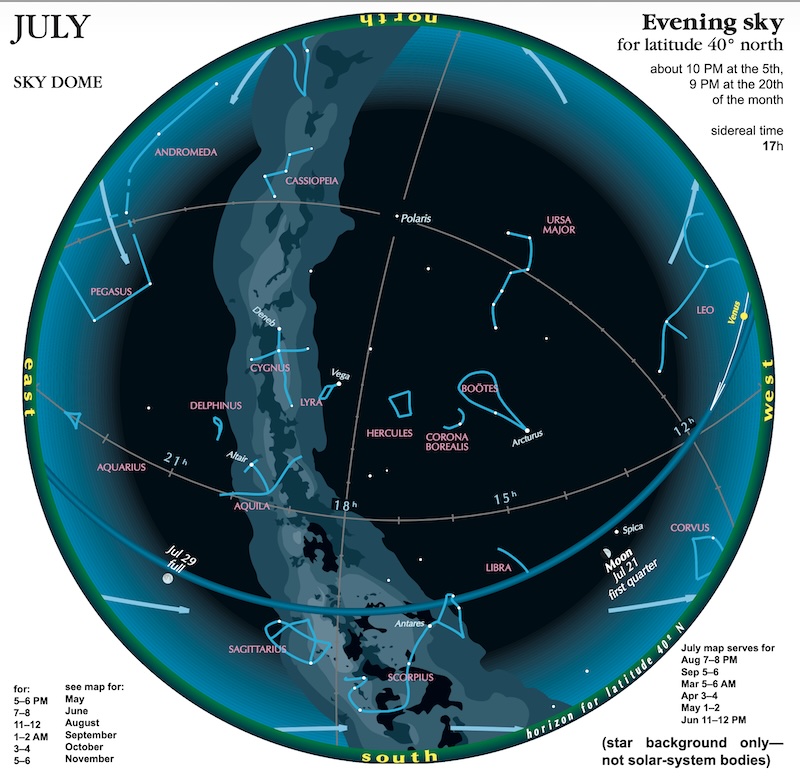
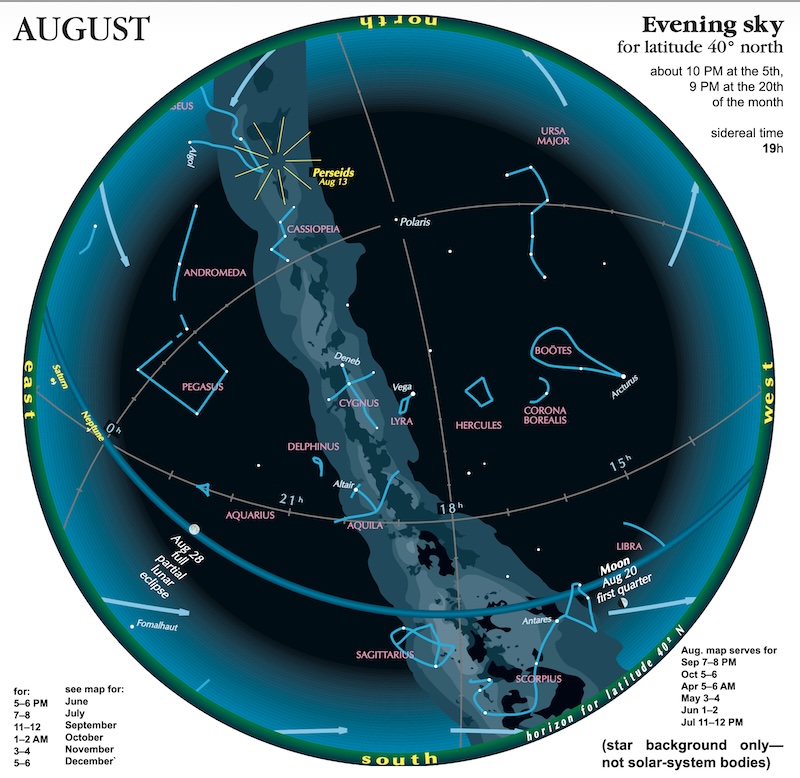
Here is the sky dome view for July 2026. It shows what is above the horizon at mid-evening for mid-northern latitudes. The view may vary depending on your location. Image via Guy Ottewell’s 2026 Astronomical Calendar.Here is the sky dome view for August 2026. It shows what is above the horizon at mid-evening for mid-northern latitudes. The view may vary depending on your location. Image via Guy Ottewell’s 2026 Astronomical Calendar.
Bottom line: EarthSky’s visible planets and night sky guide. This evening, the bulging gibbous moon lies close to the Teapot in Sagittarius, near the location of the Milky Way’s center on our sky.
Meet Marcy Curran, our voice of the night sky on EarthSky YouTube. Check out her popular short videos in the Sky category on our YouTube channel. When she's not making videos, Marcy is an EarthSky editor, helping to keep our night sky guide up-to-date and just generally helping to keep the wheels turning around here. Marcy has enjoyed stargazing since she was a child, going on family camping trips under the dark skies of Wyoming. She bought her first telescope in time to see Halley’s Comet when it visited the inner solar system in 1986. She co-founded her local astronomy club and remains an active board member. Marcy taught astronomy at her local community college for over 20 years. She and her husband live in Wyoming, in a rural location, with an all-sky camera and super-good horizon views! And, they built an observatory to capture images of the night sky.
“I can sometimes see the moon in the daytime” was a cosmic revelation that John Jardine Goss first discovered through personal observations at age 6. It shook his young concept of the universe and launched his interest in astronomy and stargazing, a fascination he still holds today. John is past president of the Astronomical League, the largest U.S. federation of astronomical societies, with over 24,000 members. He's earned the title of Master Observer and is a regular contributor to the video series, “Global Star Party.” He has authored the celestial observing guides “Exploring the Starry Realm,” and “Carpe Lunam,” and “Take Your First Steps, an Introduction to Amateur Astronomy.” John also wrote for twenty years the monthly stargazing column, Roanoke Skies, for the Roanoke Times, and currently writes a bimonthly column, Skywatch, for Blue Ridge Country magazine. He has contributed to Sky and Telescope magazine, the IDA Nightscape, the Astronomical League’s Reflector magazine, and the RASC Observer’s Handbook.
Deborah Byrd (asteroid 3505 Byrd) helps edit EarthSky.org and is a frequent host of EarthSky videos. Deborah created the EarthSky radio series in 1991 and founded EarthSky.org in 1994. Prior to that, she had worked for the University of Texas McDonald Observatory since 1976, and created and produced their Star Date radio series. She has won a galaxy of awards from the broadcasting and science communities, including having an asteroid named in her honor in 1990, a Public Service Award from the National Science Board in 2003, and the Education Prize from the American Astronomical Society in 2020. A science communicator and educator since 1976, Byrd believes in science as a force for good in the world and a vital tool for the 21st century. "Being an EarthSky editor is like hosting a big global party for cool nature-lovers," she says.
Kelly Kizer Whitt - EarthSky’s nature and travel vlogger on YouTube - writes and edits some of the most fascinating stories at EarthSky.org. She's been writing about science, with a focus on astronomy, for decades. She began her career at Astronomy Magazine and made regular contributions to other outlets, including AstronomyToday and the Sierra Club. She has nine published books, including a children's picture book, Solar System Forecast, and a young adult dystopian novel, A Different Sky.
Like what you read? Subscribe and receive daily news delivered to your inbox.
Thank you! Your submission has been received!
Oops! Something went wrong while submitting the form.
If EarthSky has ever helped you discover something new, prepare for an eclipse, spot a planet, or simply inspired a moment of wonder, today is the perfect day to give back. Your donation helps keep trusted science news, expert night sky guides, and independent science journalism free for everyone.
Please help keep EarthSky going by donating today!
Please help keep
EarthSky going!
If you've already donated, we apologize for the popup and greatly appreciate your support.